Sunulife · Sat, Apr 11, 2026 · 6 min read
Sons of Silence: When Senegalese Youth Reinvent Tradition
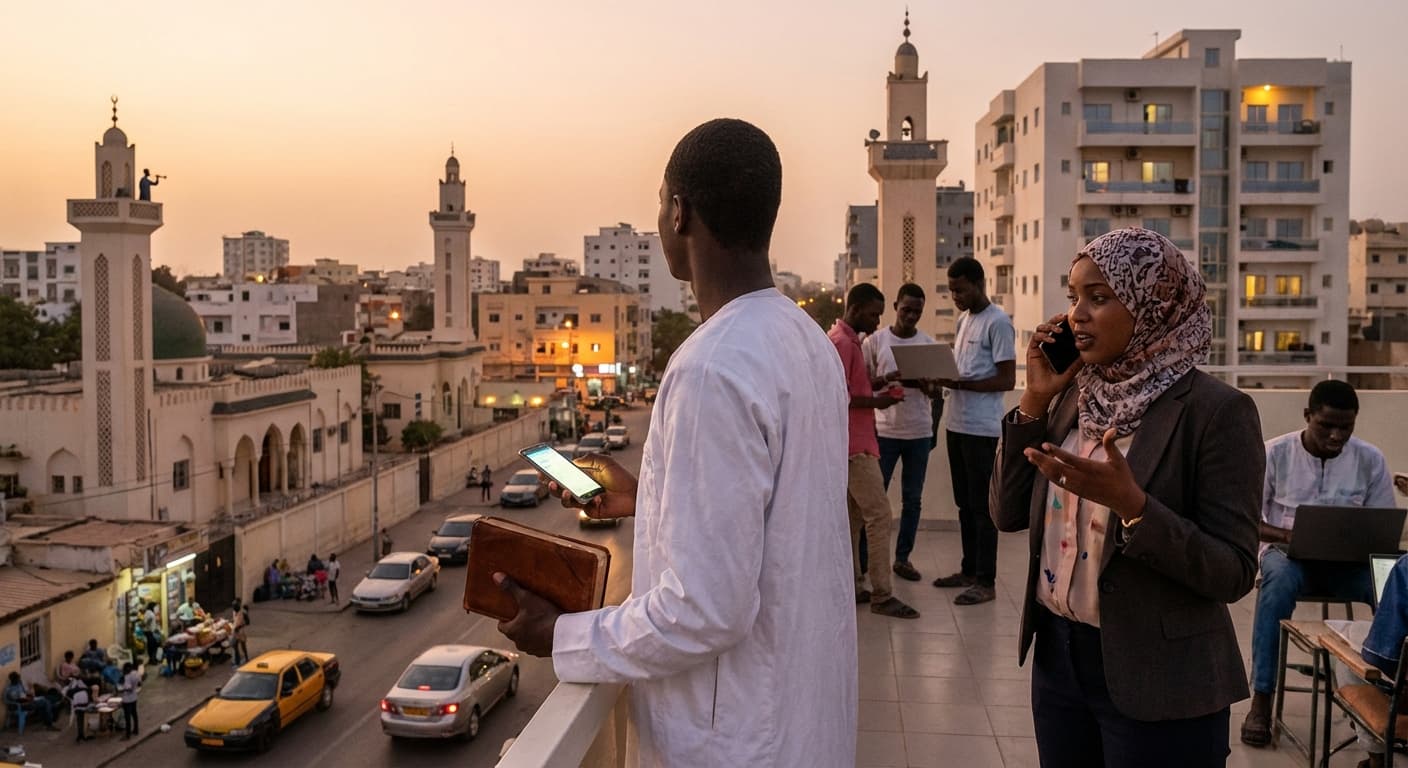
Dusk falls over Dakar with that particular softness that seems to suspend time between two worlds. On rooftop terraces, the voices of muezzins call for maghrib prayer, while inside homes, smartphone screens light up like modern fireflies. This coexistence is not mere juxtaposition: it is the daily theater where the soul of contemporary Senegal plays out, torn between fidelity to traditions and the call of modernity. Amadou, twenty-four years old, embodies this tension with painful grace. A computer science graduate, he spends his days coding for European startups, but every Friday, he dons the immaculate boubou his mother chose for him and walks to the family mosque. "I live in two temporalities," he confides, eyes lost in the orange sunset light. "One moves at fiber-optic speed, the other breathes to the rhythm of seasons and prayers. Sometimes I wonder which is more real." This duality permeates all layers of Senegalese society, but manifests with particular acuity in matters of gender and family. Aïda, twenty-eight, an architect, fights on two fronts: proving her competence in a professional environment still largely male-dominated, and negotiating with her family the idea that a woman might choose to marry after thirty. "My grandmother tells me I'm rushing through life's stages, that I risk missing the motherhood train. My mother, a retired teacher, understands my ambitions but fears the neighbors' glances. I'm simply trying to be whole." Religion, a central pillar of Senegalese identity, has also become a space for reinterpretation. Young people don't reject Islam – 95% of the population is Muslim – but they explore its margins, seeking a spirituality compatible with their existential questions. In Sufi brotherhoods, traditionally dominated by elders, study groups are appearing where youth discuss hadiths in light of contemporary challenges: ecology, social justice, gender relations. "Faith is not a museum," explains Fatou, a theology student. "It's a living garden that must adapt to new seasons without losing its roots." This quest for balance often clashes with established social structures. The concept of "teranga," that legendary hospitality that is a national pride, can become a gilded prison for those who wish to explore other life models. Community pressure, the weight of family expectations, the gaze of "ndeye ji" (gossips) create an invisible network of constraints that each generation must negotiate in its own way. Yet from this apparent contradiction emerges remarkable social creativity. Young Senegalese are inventing unprecedented cultural hybridizations: they organize "digital iftars" during Ramadan, where the breaking of the fast is shared via videoconference with the diaspora; they create platforms that reinterpret Wolof tales as digital comics; they transform traditional ceremonies into contemporary artistic performances. This generation doesn't reject the past – they dialogue with it. As the Fulani proverb says so well: "When an old man dies, a library burns." But young Senegalese silently add: "And a youth that thinks is a new library opening."
The real challenge is not choosing between tradition and modernity, but inventing a third way, specifically African, where respect for ancestors doesn't smother descendants' dreams. In the streets of Dakar, Saint-Louis, Thiès, this new identity cartography is gradually taking shape, where mosques neighbor coworking spaces, where griots tell stories on YouTube, where women wear hijabs with professional blazers.
This silent transformation may be the deepest revolution Senegal is experiencing today. Without manifestos or barricades, but in the intimacy of daily choices, a generation is reinventing what it means to be Senegalese in the 21st century. They are the sons of silence – not because they are silent, but because their speech is built through patience, nuance, and that deep conviction that Africa's future will be neither a copy of the West nor nostalgia for the past, but a living, bold, resolutely African synthesis.
As poet Léopold Sédar Senghor, himself torn between two worlds, said: "I am the son of being torn apart." Today, his heirs are learning to make this tearing not a wound, but a richness, an identity polyphony where all voices – those of ancestors, those of parents, and their own – can finally sing in harmony.
In this delicate balancing act, technology plays an ambiguous role. Social media platforms become both bridges and battlegrounds. Young women share their professional achievements on Instagram while carefully curating images that won't offend conservative relatives. Men discuss football and politics in WhatsApp groups that span continents, creating a digital diaspora that influences local perspectives. The very tools that connect Senegal to global conversations also amplify internal tensions, making private negotiations suddenly public, family discussions potentially viral.
The education system itself becomes a site of this cultural negotiation. Students return from universities in France, Canada, or the United States with new ideas about gender equality, environmentalism, and personal freedom, only to find themselves expected to conform to social codes that haven't evolved at the same pace. This creates what sociologists call "cultural bilingualism" – the ability to navigate different value systems, sometimes within the same day, the same conversation, even the same sentence.
Perhaps what makes the Senegalese experience particularly instructive is its refusal of binary thinking. Unlike societies that experience sharp generational breaks or violent cultural revolutions, Senegal moves through what might be called "evolution by incorporation." New ideas aren't rejected outright but are filtered through existing cultural frameworks, tested against community values, and adapted until they can be integrated without causing rupture. This process is messy, often frustrating for those pushing for faster change, but it may ultimately prove more sustainable than sudden upheavals.
As night fully embraces Dakar, the city's sounds create their own synthesis: the distant hum of generators mixes with recorded Quranic recitations; motorcycle taxis weave through streets where women still pound millet in courtyards; in cybercafés, young people video chat with relatives in Europe while traditional healers prepare remedies in nearby shops. This isn't chaos – it's complexity. It's a society learning to hold multiple truths simultaneously, to be both deeply religious and progressively modern, both communally minded and individually ambitious.
The true measure of this transformation won't be found in political declarations or economic statistics, but in the quiet moments of everyday life: in the daughter who explains to her mother why she wants to start a business rather than marry immediately; in the son who prays at the mosque then returns home to develop an app addressing local agricultural challenges; in the grandmother who learns to use a tablet to see photos of grandchildren abroad. These small acts of negotiation, these daily bridges between worlds, are where Senegal's future is being built – not with dramatic gestures, but with patient, courageous, loving persistence.