Narratives
Sunulife · Fri, Jul 10, 2026 · 2 min read
The Colors of Silence
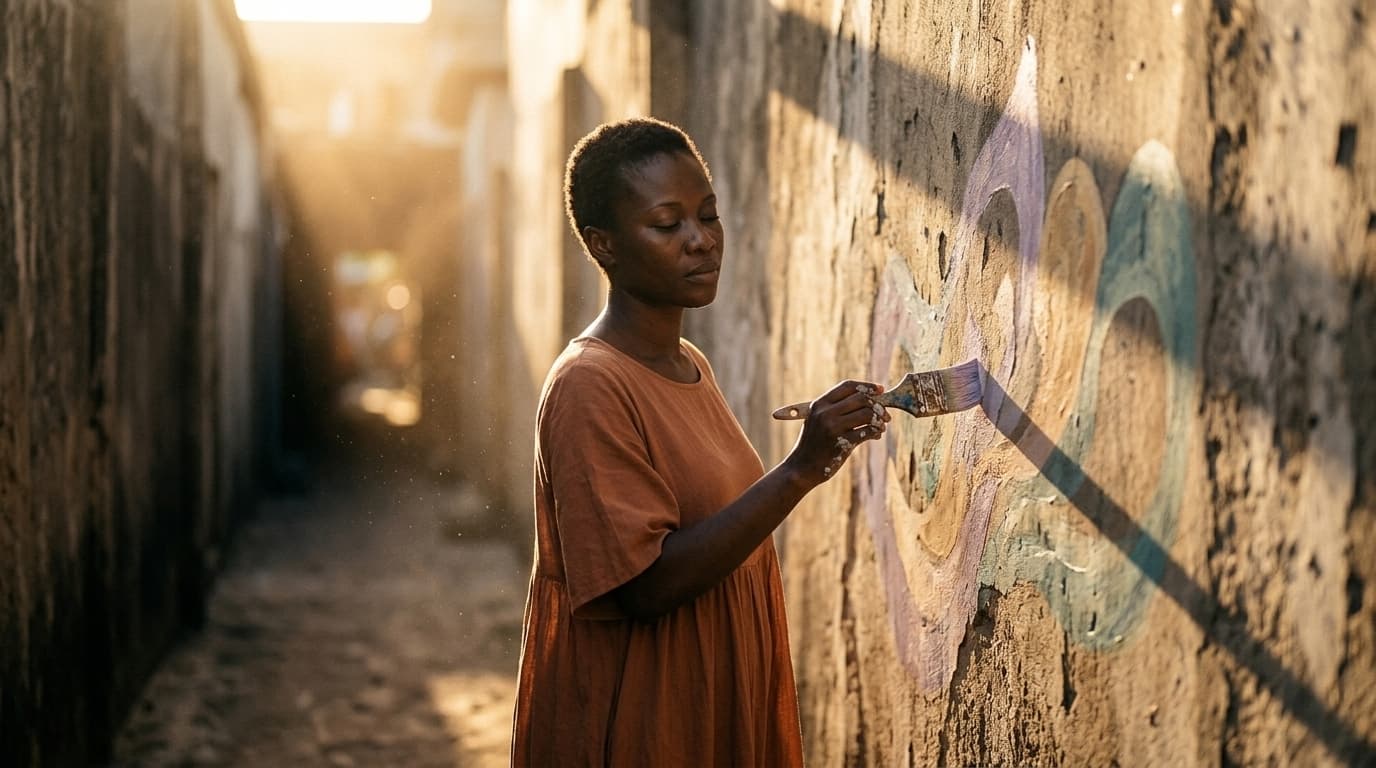
The midday sun crushes the alley into a near-liquid white. The brick walls, gnawed by humidity and time, drink the light like an offering. It is here, in this forgotten crevice between two buildings, that I find her for the first time. Her name is Awa, but her real name—the one she carries in the hollow of her sternum—no one speaks it anymore. She holds a paintbrush like one holds a hand they don't want to let go. Before her, a bare wall, a rectangle of silence. Her movements are slow, almost liturgical. She does not paint forms or patterns. She applies colors—night blue, earth red, a yellow that seems to come from another world. But this is not paint. It is liquid memory. "Every color has a sound," she says without turning her head. Her voice is hoarse, worn from too many swallowed words. "The blue is the sound of the sea when my father left in his pirogue. The red is my mother's cry the day he did not return. The yellow..." She pauses, brush suspended. "The yellow is the silence afterward." I came to Abidjan to write about street artists—those who transform the city's scars into open-air galleries. But Awa is not a street artist. She is an archivist of the invisible. For three years, she has traveled through the working-class neighborhoods of Treichville and Yopougon, searching for forgotten walls to deposit what she calls "the colors of silence." These are the colors of things left unsaid, goodbyes without ceremony, loves that died before they could live. She tells me her