Narratives

Sunulife · Mon, May 25, 2026 · 4min read

The River of Lost Words

The River of Lost Words
Favourite

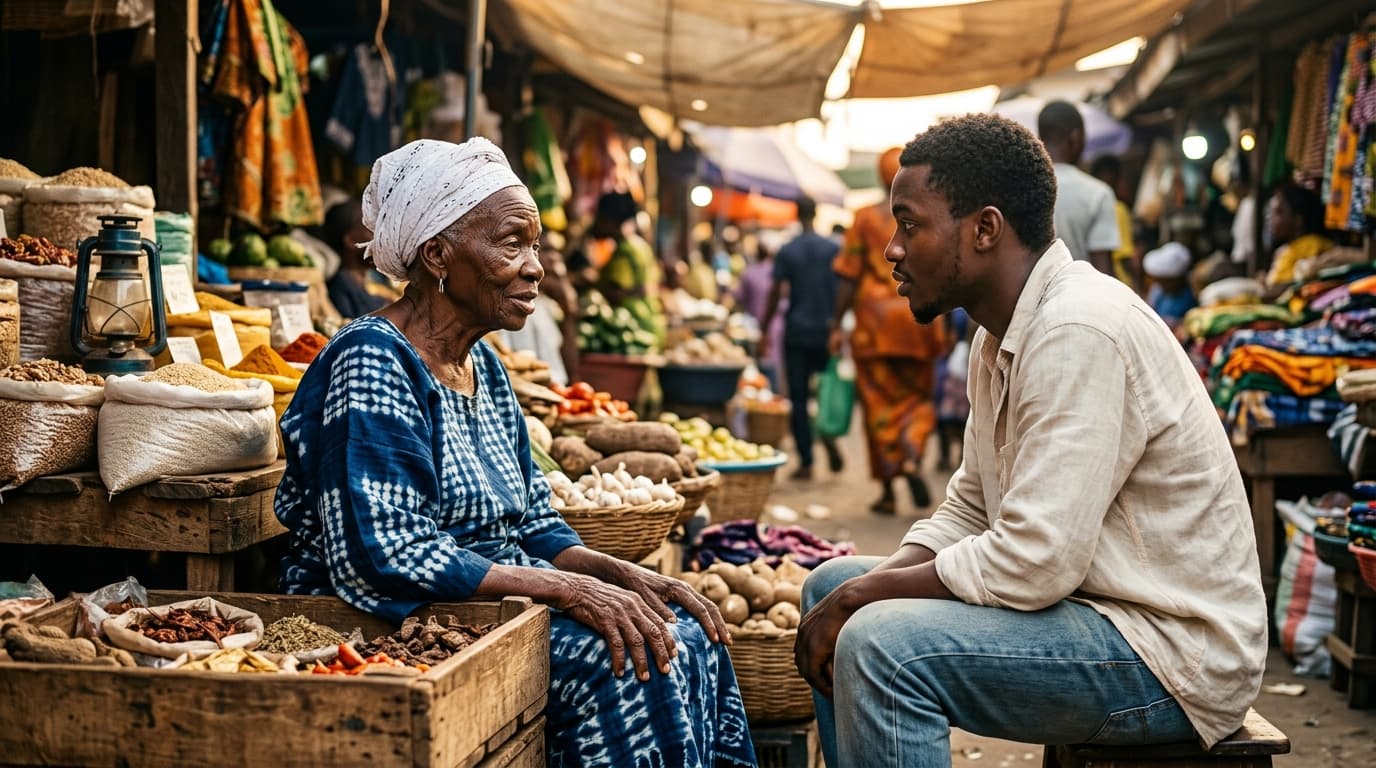
At the Balogun market, under a corrugated iron awning weeping rust, Mama Ireti keeps her stall. Around her, the cacophony of fabric sellers, the honking of danfos, the smell of smoked fish and kerosene. But her space is an island of silence. She sells neither yams, nor wax print, nor refurbished phones. She sells stories. People pass, stop, look at her. She is old, her face carved with deep wrinkles like furrows after rain. Her eyes, veiled with cataracts, seem to look beyond things. Before her, a chipped calabash. You drop a coin in it, and she speaks. Not long. A few minutes. But those who listen leave with something heavier than a shopping bag. She says she does not choose the stories. The stories choose her. Sometimes she tells of the child who crossed Benin on foot, feet bleeding, to find his mother. Sometimes of the man who built a bridge with his bare hands, a bridge no one ever saw. Sometimes of the woman who cried so hard her tears formed a river, and that river washed away her cheating husband's house. People laugh, but they listen. That day, a young man in a starched white shirt stops before her. He holds a phone, headphones around his neck. He looks like those who work in the glass towers of Ikeja, those who have forgotten the taste of earth. He hesitates, then drops a fifty-naira coin into the calabash. Mama Ireti looks up. She stares at him for a long time. Then she says, 'You came looking for a story, but you are the one who has one to give.' The young man freezes. He wants to protest, but his throat tightens. He sits on the ground, legs crossed, like a schoolboy. Around them, the market buzzes on, but their bubble is sealed. 'Tell me what you wrote,' she says. He starts. How can she know? He writes, yes. For years. Poems, fragments, stories he dares not show anyone. He keeps them in notebooks under his bed, in password-protected files. He fears his words will be stolen, or worse, judged unworthy. 'I wrote a story,' he whispers. 'But they say it isn't mine.' Mama Ireti nods. 'Words have always had many fathers. What matters is the river they come from.' He tells her about the competition, the recognition, then the accusation. They said his text was written by a machine. Artificial intelligence. He couldn't defend himself. How do you prove you are the author of your own tears? The old woman leans forward. Her knotted fingers touch the young man's forehead. 'Machines do not know how to cry,' she says. 'They have never lost anyone. They have never loved someone so much it hurts. You have.' Then she tells him the story of a griot, long ago, in a village up north. The griot owned the word. Everyone came to listen. But one day, a stranger arrived with a box that recorded voices. The griot sang, and the stranger took his song. Later, the song played on the radio, without the griot's name. But every time it played, the griot, hundreds of miles away, heard it. Because the song belonged to him, it always returned. 'Your words are in you,' she says. 'No one can take them. If you wrote them with your blood, they will carry your name, even if it is erased.' The young man cries. No shame, no sound. Tears simply flow, like a silent river. He thinks of his mother, dead when he was ten. Of how he taught himself to read, from the books she left him. Of the first poem he wrote, at twelve, on the cover of a school notebook. That poem, he knows by heart. He recites it softly for Mama Ireti. She closes her eyes. When she opens them, she smiles. 'That is a good story,' she says. 'Now go. Write the next one.' He stands, bows, and disappears into the crowd. He does not yet know that he will win the case, that his text will be recognized, that his name will remain. But that day, at Balogun market, he found something more precious than recognition: the certainty that his words come from him, from his flesh, from his memory. Mama Ireti sets the calabash back in place. The market continues. Another person stops. Another coin falls. And another story begins.