Sunulife · Wed, Apr 15, 2026 · 4 min read
Digital Dreams of Dakar: When AI Redraws the Boundaries of Creation
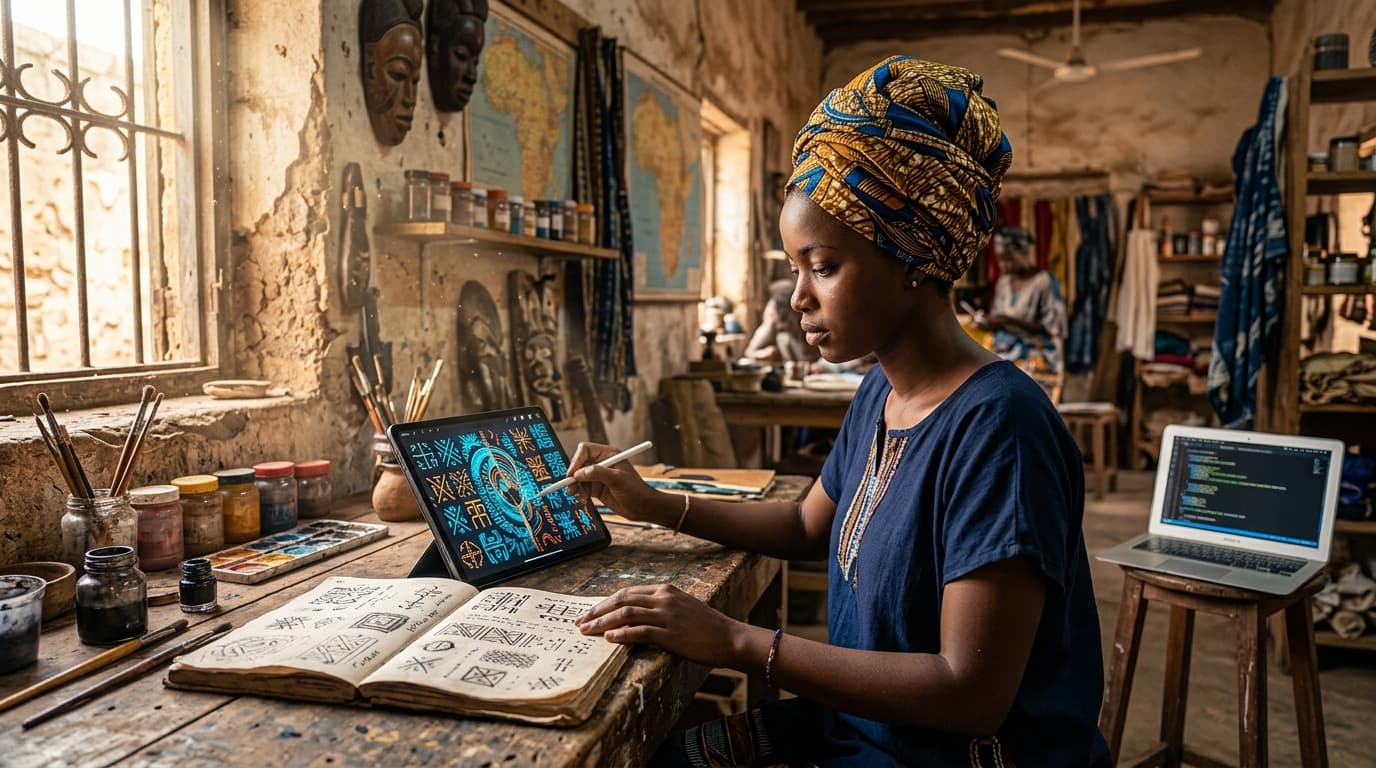
Aïssatou's workshop smells of incense and pigment dust. On the terracotta walls, ancestral portraits converse with screens where AI-generated geometric forms dance. The young woman's hands, slender and stained with ink, simultaneously caress a graphics tablet and an old, worn leather sketchbook. She has been working since dawn, suspended between two worlds that constantly echo each other. At twenty-six, Aïssatou Diallo has unwittingly become the embodiment of a question haunting African artistic circles: who owns culture when machines learn to create? Her journey began in the alleyways of Dakar's Medina, where her grandfather, a master weaver, taught her Wolof patterns passed down through generations. Each symbol told a story, each color carried memory. "Patterns aren't decorative," he would say, guiding her small hands. "They're doors to the ancestors." Then came studies at the School of Fine Arts, the discovery of digital tools, and that scholarship to an algorithmic creation lab in Paris. There, Aïssatou watched artists feeding artificial intelligences with thousands of images of African masks, traditional textiles, ancient sculptures. The machines would then produce infinite variations, sold as works "inspired by African cultures." She remembers her discomfort facing these orphaned creations, uprooted from their ritual context, their spiritual meaning. "It was like watching ghosts dance without knowing their stories," she confides, her eyes drifting toward the window where the golden evening light filters through. Back in Dakar, Aïssatou decided to create differently. In her workshop, she developed a singular project: an artificial intelligence she feeds exclusively with her own creations, her research notebooks, recordings of family stories, patterns learned from her grandfather. The algorithm becomes a collaborator, a digital echo of her personal and family memory. "I don't want the machine to learn African culture," she explains. "I want it to learn my Africa, the one I inherited and am transforming." The process is slow, complex. Entire nights spent coding, adjusting parameters, dialoguing with this digital entity that begins producing unexpected forms. Sometimes, the AI generates patterns that strangely resemble her grandfather's, but with variations no human would have imagined. Other times, it creates completely new compositions that nevertheless "feel" right, as if the machine had grasped the invisible essence connecting all of Aïssatou's work. This approach raises profound questions. During a recent exhibition, a European collector wanted to buy not only Aïssatou's physical works but "the algorithm itself," offering a contract reminiscent of the music industry's "360 deals" where artists surrender rights to all future revenue. Aïssatou refused. "The algorithm is my digital workshop, my creative space. Selling it would be selling my hand, my gaze, my memory." Around her, Dakar's art scene is abuzz. Some see in AI a new form of digital colonialism, where African cultural data is extracted, processed, monetized far from its source. Others perceive an opportunity for reinvention, for creating new visual languages. Aïssatou navigates between these poles, seeking a third way. "We can't ignore these technologies," she says. "But we must tame them in our own way, with our own rules, our own ethics." In the workshop's dim light, screens emit a bluish glow that mingles with candlelight. Aïssatou shows on her computer the latest generations from her AI: organic forms evoking both baobab roots and printed circuits, colors recalling traditional dyes and cybercafe neons. "Look," she whispers. "It's a new cartography. Not of political borders, but of memories that travel, transform, survive." Outside, Dakar vibrates with its millennial contradictions. Calls to prayer blend with smartphone notifications, rickshaws pass motorcycle deliveries for digital platforms. In this ferment, Aïssatou continues her patient work, weaving connections between ancestors and algorithms, between earth and cloud. Her story isn't that of an artist confronting technology, but of a creator inventing new ways of being African in the 21st century. A fragile, essential quest redefining what it means to inherit, create, and transmit in a world where memory itself becomes programmable. Her hands move between traditional materials and digital interfaces, each gesture a bridge across time. The workshop becomes a microcosm of larger tensions playing out across the continent—between preservation and innovation, ownership and sharing, the local and the global. Aïssatou's AI doesn't just generate art; it becomes a mirror reflecting the complex negotiations of contemporary African identity. As night deepens, she saves her work, the soft hum of computers blending with distant city sounds. On one screen, ancestral patterns morph into futuristic landscapes. On another, code scrolls like digital incantations. Aïssatou smiles faintly, recognizing in these hybrid creations not a loss of tradition, but its unexpected evolution. Here, in this modest Dakar workshop, the future of African cultural sovereignty is being written—not in declarations or policies, but in the quiet, determined work of an artist who remembers where she comes from while imagining where she might go.