In the opening days of 2026, the international community finds itself at a crossroads. From the recent interventions in Venezuela to the shifting power dynamics in the Middle East, a uncomfortable truth has resurfaced in the global consciousness: International Law is often less a rigid code and more a flexible contract.
For the modern leader or global citizen—particularly those balancing identities across continents like Africa and North America—this "Law of the Jungle" isn't just a political reality; it is a significant source of cognitive load and "existential burnout."
To thrive in an inherently anarchic world, we must understand the mechanics of power and, more importantly, how to manage our own "Circle of Influence."
1. The Myth of Universal Enforcement
Management theory often distinguishes between formal authority and actual power. In domestic settings, we have the "Rule of Law." Internationally, we often operate under "Rule by Law."
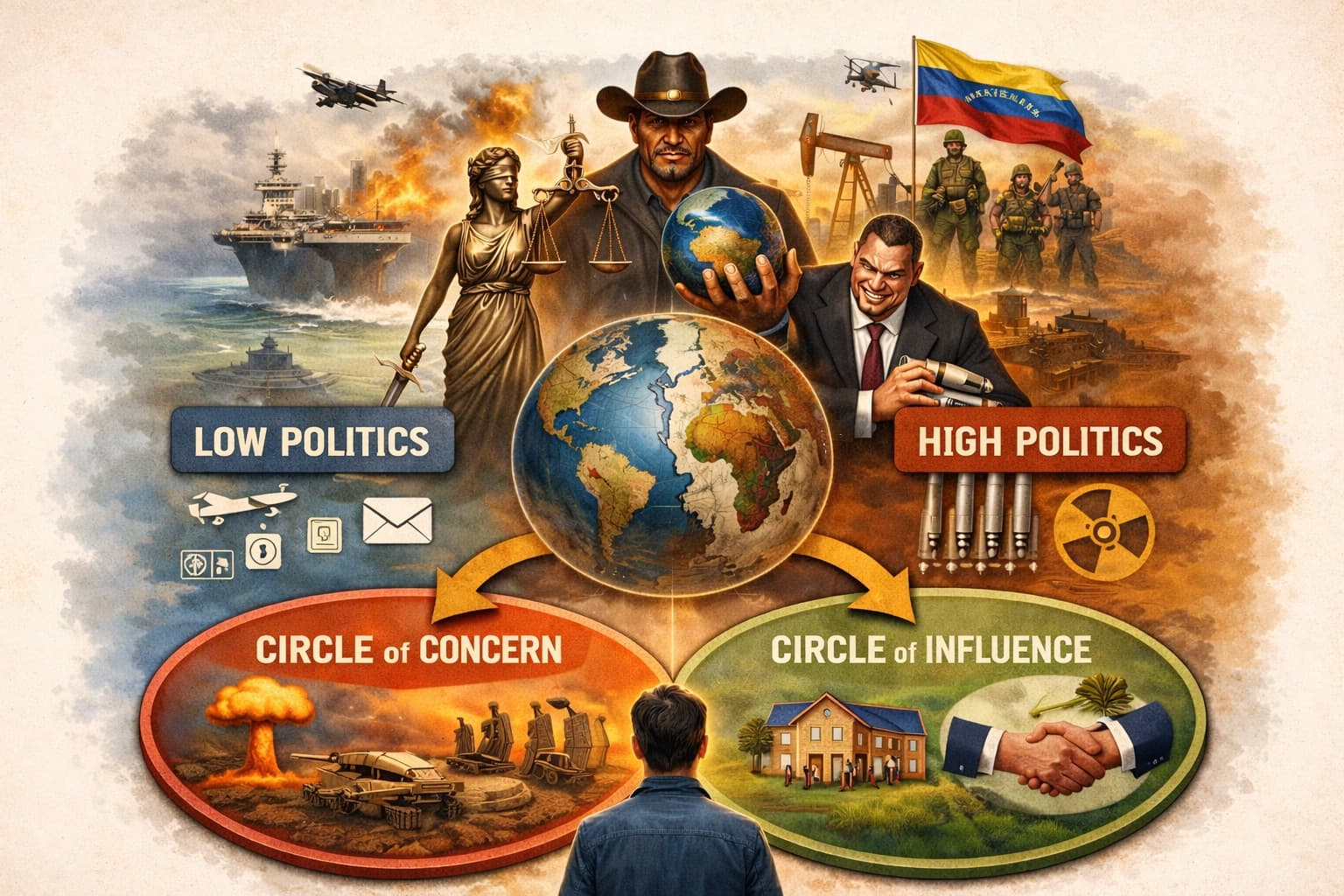
Low Politics (The Infrastructure): This is where the world works. Treaties governing civil aviation, postal services, and digital trade function because of reciprocity. Nations follow these rules because the cost of isolation is too high.
High Politics (The Security Gap): This is where the "Sheriff" resides. In matters of sovereignty and nuclear deterrence, the world remains anarchic. Powerful nations often act as "Sheriffs," enforcing order when it aligns with their interests and bypassing it when it does not.
2. The Sheriff vs. The Bully
The central tension of 2026 is not the absence of a "Global Sheriff," but the lack of accountability for that role. When an enforcer acts unilaterally, the "Security Dilemma" is triggered: one nation's quest for security is perceived as another's threat.
For the observer, this creates a sense of profound unfairness. We see the "Bully" dynamic—where wealth and weapons dictate the terms of engagement. Acknowledging this reality is not cynical; it is intellectually honest. However, dwelling on it without a framework for action leads to paralysis.
3. The Psychology of the "Curious Observer"
Many high-performing individuals (particularly those with a Dominance/Influence (Di) personality profile) feel a natural urge to solve these global "inefficiencies." We overthink global conflicts because we are wired for action and results.
When we cannot influence the "Global Sheriff," our internal system registers this as a "loss of control," leading to physical and mental stress.
4. A Framework for Personal Stability
To cope with global anarchy while maintaining a focus on personal and professional growth, we propose a three-pillar strategy:
Audit Your Information Diet
In a digital age, "Breaking News" is designed to trigger a fight-or-flight response.
The Shift: Move from "Reactionary Consumption" (social media feeds) to "Foundational Learning" (long-form history or economic analysis). Understanding the why of a conflict is more grounding than tracking the what of every hour.
Distinguish Between Concern and Influence
The "Circle of Influence" (a concept popularized by Stephen Covey) is vital here.
Circle of Concern: Global wars, nuclear proliferation, superpower bullying. (Influence: 0%)
Circle of Influence: Your business, your family, your community in Senegal or Canada, your physical health. (Influence: 100%)
The Strategy: Invest 90% of your mental energy where you have 100% influence.
Practice "Micro-Leadership"
You may not be able to fix the UN Security Council, but you can enforce a "Rule of Law" in your own life. By being a fair, consistent, and ethical "Sheriff" in your own business and home, you create a pocket of order in a chaotic world.
The Executive Summary
The world is, and has always been, a complex mix of cooperation and "the law of the jungle." While the "Global Sheriff" may often act as a bully, our primary responsibility is to ensure that the global chaos does not become internal chaos.
By focusing on local impact and high-value curiosity, we can stay informed without being consumed. In 2026, the greatest act of defiance against a chaotic world is to maintain one's own peace and purpose.