An Ordinary Day Under the Tropical Heat
It was a swelteringly unbearable day in Casamance, southern Senegal, where the relentless sun seemed to scorch everything in its path. In the early afternoon, I was returning from Ziguinchor with two of my employees, Augustin and Mass. We decided to stop at a crocodile farm, curious to gather ideas for caring for the baby crocodiles I had recently acquired. A few weeks earlier, some village kids from Elinkine, where I had settled a few months ago, sold me these tiny reptiles. They had found them in a nearby pond and, sensing an opportunity, decided to offer them to the "white guy" who had recently moved into their village.
The visit to the farm was filled with laughter and lively banter. But suddenly, an odd sensation washed over me. A peculiar internal heat, distinct from the tropical climate, began to spread through my body at an alarming rate. I had felt this before: the onset of a malaria attack. However, this one felt far more intense than any I had experienced previously.
A Race Against the Fever
I turned to Augustin and Mass, trying to keep my voice steady despite the growing urgency within me. "Guys, I’m having a malaria attack." They burst out laughing, probably thinking I was exaggerating. But I was the only one among us who could drive, and it was critical to get back to Elinkine before the fever rendered me unable to steer. The sensation was bizarre: an insidious warmth creeping through me, accompanied by an overwhelming fatigue that settled in rapidly.
On the way, we stopped in Oussouye, where I rushed to a pharmacy. After describing my symptoms, the pharmacist handed me Quaterne, an antimalarial drug. Back in Elinkine, a visit to the health post confirmed the diagnosis. Barely two hours after the symptoms began, I was already staggering, struggling to keep my eyes open. At the camp I managed, I briefly greeted the guests before collapsing onto a mattress laid directly on the floor in the office next to the restaurant.
Lost in the Haze of Fever
What followed is a blur. My body alternated between uncontrollable chills and profuse sweating. Violent tremors shook me, and I slipped into a strange state of semi-consciousness, hovering between wakefulness and oblivion. I could hear voices—perhaps those of the restaurant’s patrons—but I couldn’t make sense of their words or muster the strength to respond. Time stretched into an elusive haze. Was it day or night? I had no idea.
In this delirious state, an unexpected visitor appeared. Déguenne, a young woman I had recently parted ways with, entered the room. Despite the fever, the anger from our breakup flared up. I managed to mutter, “What are you doing here?” She said she came to collect her belongings. “Take them and get out!” I snapped, exhausted but still harboring resentment.
She persisted, noticing my condition. “What’s wrong with you?”
“Malaria, can’t you see?”
“Have you treated it?”
“Yes, it’s fine, just leave me alone.”
The conversation ended there, or so I recall. She left, and I sank back into a restless sleep, racked by waves of fever and tremors. My phone rang repeatedly. It was Déguenne again, urging me to “come to the house.” Too weak to argue, I eventually stopped answering, ignoring the ringtone that faded into the background.
A Worsening Crisis
By the second day of the malaria attack, my condition had deteriorated drastically. I was nearly comatose, overwhelmed by a weakness unlike anything I had ever felt, even during my worst bouts of flu. I had been living in Casamance for just eighteen months, and this was my third malaria episode. Each one seemed more severe than the last, and I began to wonder how long I could endure this.
Augustin came to check on me, likely in the morning. “You should go see Déguenne,” he said. I refused, too frail to consider moving, let alone driving. He insisted, mentioning that she had called him. In a mix of determination and desperation, he offered to carry me to her place, over a kilometer away. The mental image of Augustin hauling me on his back through the village almost made me laugh, despite my state.
Ultimately, he proposed a bolder plan: driving me in my own car, despite never having driven before. “You’ll show me how,” he declared with unsettling confidence. Too exhausted to argue, I gave in. He carried me to the car, and what followed was a chaotic ordeal. I weakly explained how to use the clutch and accelerator. The car stalled repeatedly, lurching forward in fits and starts. By some miracle, we made it through the village in first gear, the car jerking like a bucking bronco. Utterly drained, I was half-dozing when Augustin carried me into Déguenne’s house, about a kilometer from the camp.
A Mysterious Healing
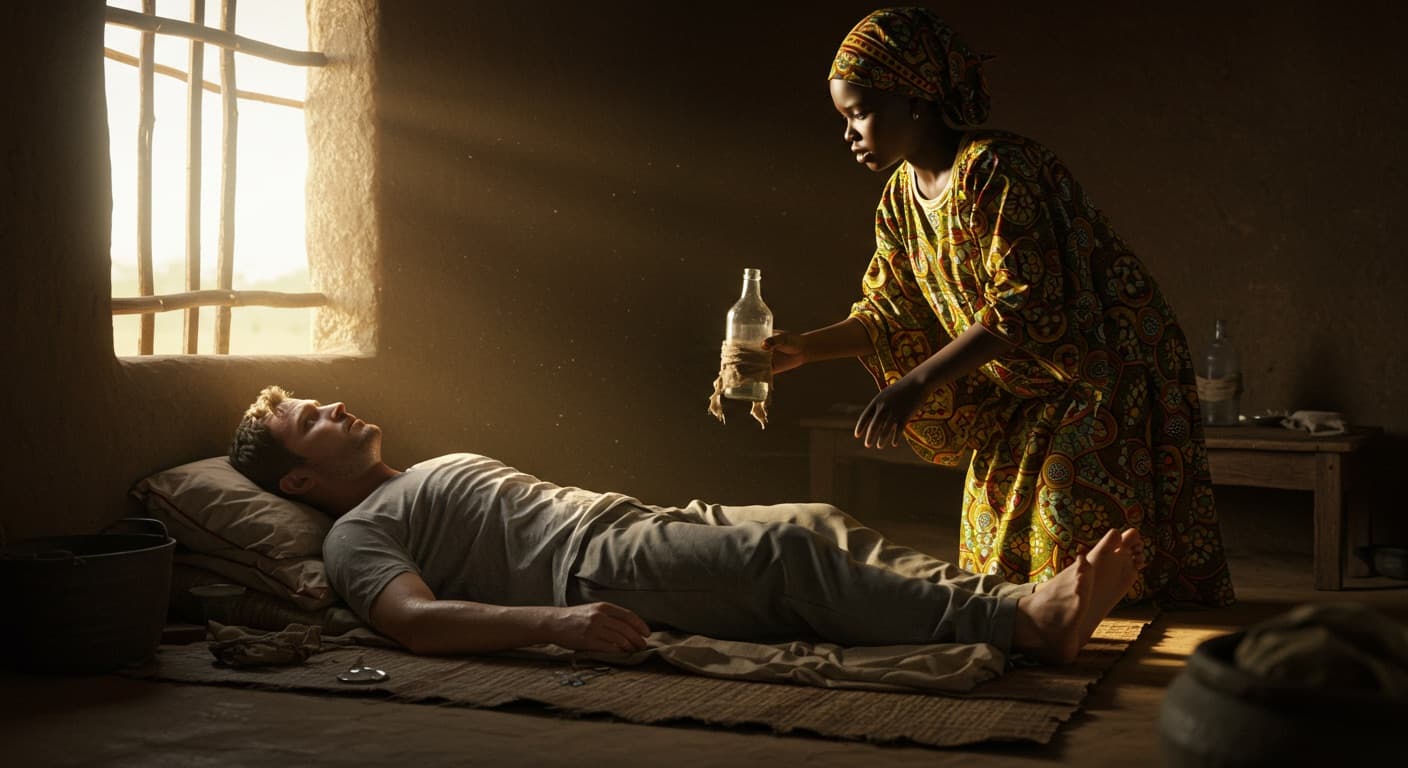
I don’t know how long I slept, but when I awoke, Déguenne was there, watching over me. She asked if I could sit up. With effort, I managed. She then retrieved a glass bottle wrapped in old rags, filled with a clear liquid. “Drink,” she instructed.
“What is it?”
“Water from a marabout in Touba.”
Skeptical, I couldn’t resist a jab: “Are you trying to put a spell on me?”
She gave a faint smile. “Why do you think I never get malaria?”
After a moment’s hesitation, I decided to trust her. What did I have to lose? I drank three glasses of the water, then, following her instructions, poured some over my head three times. Exhausted from the effort, I slipped back into sleep.
When Augustin returned to fetch me—still driving, with slightly less disastrous results—I felt different. The fever seemed to have subsided. And from that day forward, I never had another malaria attack.
Mysticism or Mere Coincidence?
Was it the marabout’s blessed water? My immune system finally overcoming the parasite? Pure luck, or perhaps a combination of all three? I’ll never know for certain. Deep down, though, I believe in the power of the beliefs and rituals of this mystical land called Casamance. This experience, blending illness, tradition, and an unexpected reconciliation, left an indelible mark on me. It taught me that sometimes, healing comes from places we could never have imagined.