
Narratives

Sunulife · Fri, May 29, 2026 · 4min read

The Silence of the Mango Trees
The Silence of the Mango Trees
Favourite

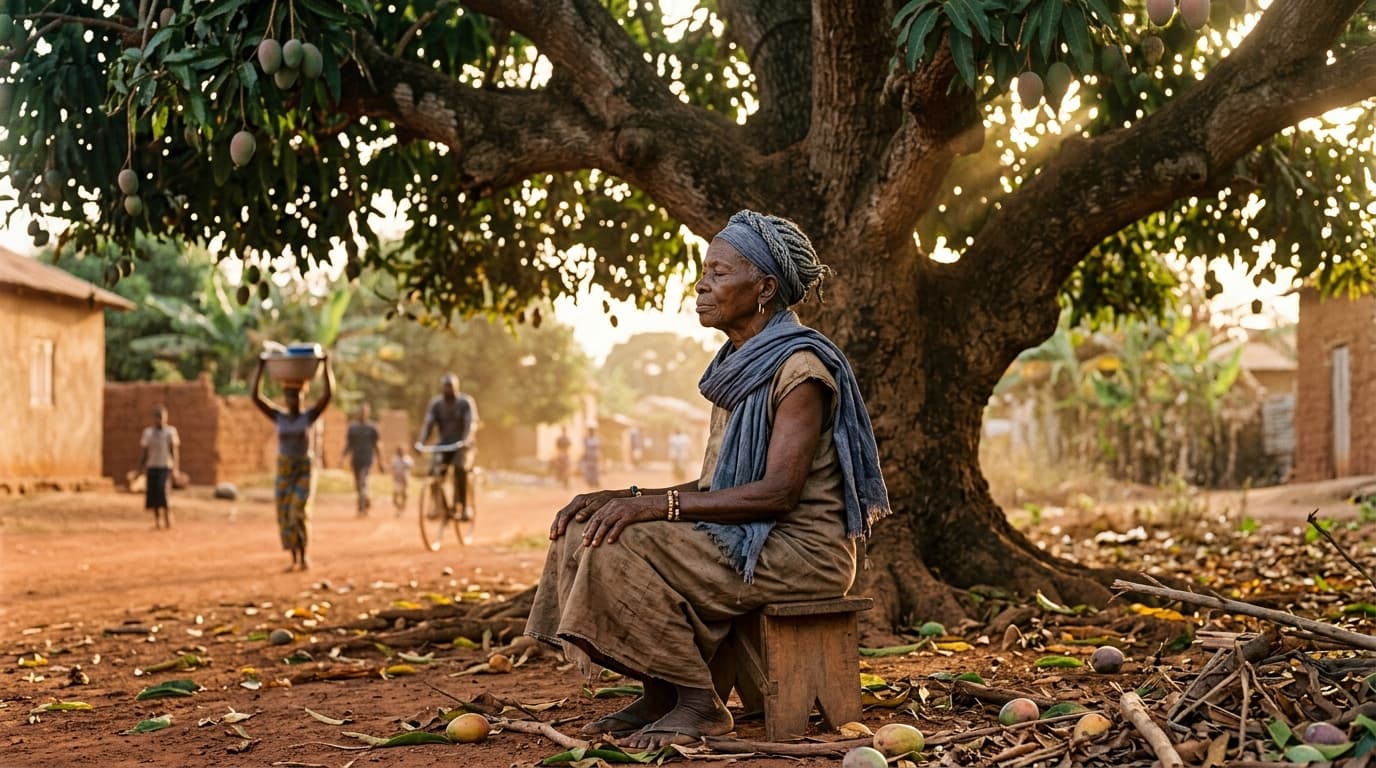
The midday sun crushes Ouidah. The waves of the Gulf of Guinea die on the white sand, where once rusty chains sealed the fate of millions of souls. Under a mango tree whose branches bend under the weight of fruit, a woman sits. Her name is Maman Kossiwa, but no one remembers it anymore. To the neighborhood children, she is the "mango tree madwoman." To the adults, a ghost haunting the roadside. She wears a wax print cloth whose patterns have been erased by seasons, a white scarf tied around her forehead. Her hands, bony and calloused, rest on her knees like two tired birds. She never speaks. She stares at the horizon, where the sea meets the sky, where boats disappear. Every morning, she leaves her tin shack and walks the two kilometers to the tree. She sits in the same spot, back straight, eyes fixed. The fish sellers, under the shade of torn umbrellas, shrug. "She is waiting for her husband," they whisper. "He went to sea forty years ago." But that is not quite it. Maman Kossiwa's story begins long before her birth, in the bowels of a slave ship. Her great-grandmother, Adjoa, had been torn from the kingdom of Abomey, chained in the hold of the "Soleil de Gloire," a French three-master. But legend says that at the moment of crossing the door of no return, Adjoa planted a mango pit in the sand. "I will return," she murmured. The ship weighed anchor, and Adjoa never came back. But the pit, it sprouted. The mango tree grew, slowly, like a promise. It saw the colonizers build their forts, the missionaries plant their crosses, the independences wrested in blood. It saw exiles, returns, grief. And one day, a little girl named Kossiwa came to sit under its shade. She did not know why. She only felt that this tree spoke, in a voice without words. At sixteen, Kossiwa fell in love with a fisherman, Kwamé. He was a gentle man, with broad hands, who laughed like thunder. They met under the mango tree, away from prying eyes. Kwamé told her stories of the depths, fish that carry messages, wrecks that hold treasures. She listened, and the wind in the leaves seemed to approve. But happiness is as fragile as a soap bubble. One morning, Kwamé went to sea and did not return. The pirogue was found empty, drifting offshore. Some spoke of a storm, others of a spell cast by a rival. Kossiwa refused to believe in death. She returned to the mango tree, day after day, waiting for the sea to give back its own. The years passed. Her hair turned white, her skin wrinkled, but she did not move. The mango tree became her landmark, her refuge, her kingdom. The villagers, first sympathetic, eventually teased her, then ignored her. But she remained, motionless, eyes lost. What people do not know is that Maman Kossiwa has learned to hear the roots. Underground, the roots of the mango tree sink deep, crossing centuries, connecting continents. They reach the shores of Brazil, Cuba, Haiti. They whisper the names of the disappeared, the songs of captives, the prayers of mothers. And among these voices, Kossiwa distinguishes that of Adjoa, her ancestor, speaking in a forgotten tongue. And sometimes, when the wind blows hard, she thinks she hears Kwamé's laughter, mingled with the sound of the waves. Today, a real estate developer covets the land. He wants to build a luxury hotel, with a pool and ocean view. Local authorities hesitate. The mango tree is a century old, perhaps classified. But money talks loudly. Maman Kossiwa knows nothing of the threats. She continues to sit, each day, under the tree. She has become the tree. When asked why she waits, she does not answer. But her eyes, sometimes, light up with an ancient gleam, as if she sees something others do not. Perhaps the mangrove will one day swallow the hotel. Perhaps the sea, as it always has, will reclaim its rights. In the meantime, an old woman and her mango tree guard the memory of a world that refuses to die. And in the silence of the mango trees, Africa still speaks.