Narratives

Sunulife · Tue, Mar 31, 2026 · 5min read

The Silences of Lagos

The Silences of Lagos
Favourite

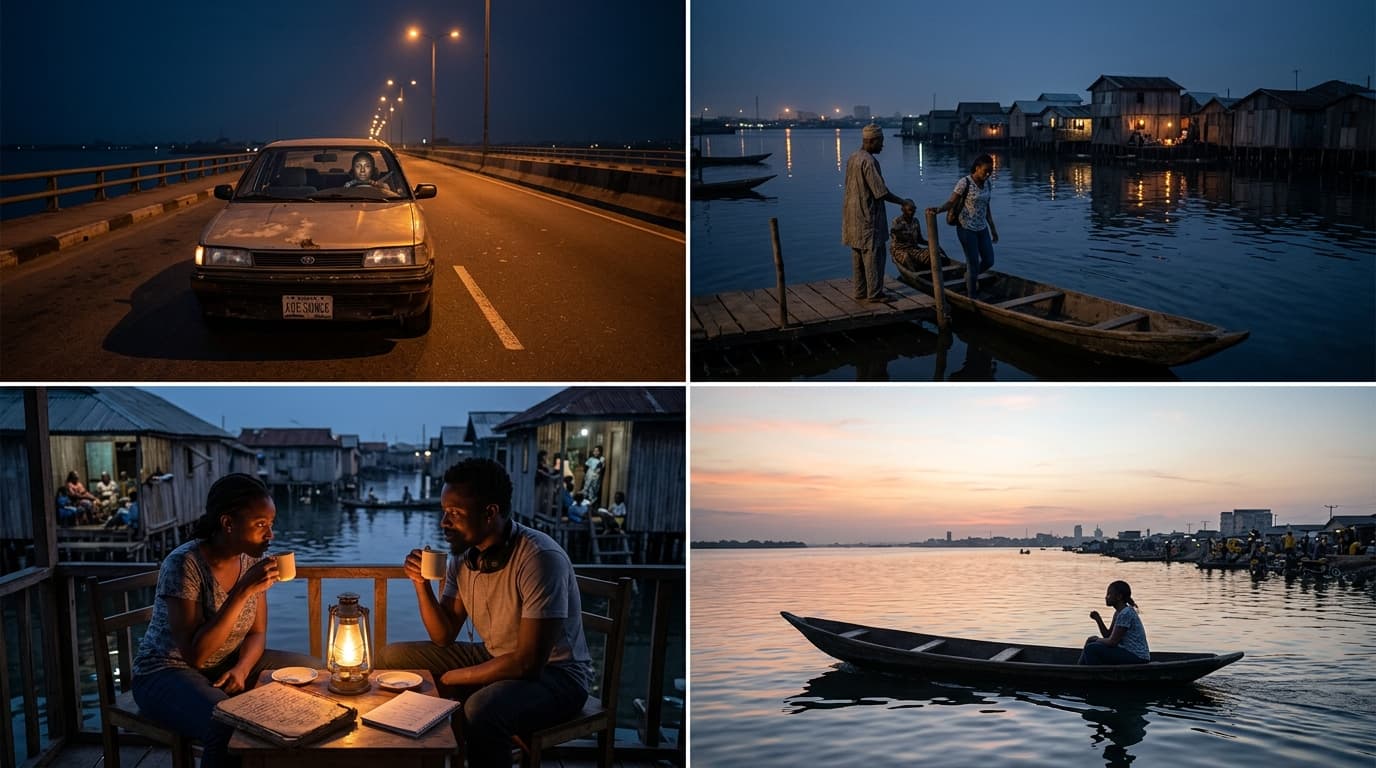
It is three in the morning in Lagos, and the city has shed its skin. The strident horns that had torn through the sky since dawn have fallen silent, replaced by the distant hum of generators and the lapping of water against the stilts of Makoko. On the Third Mainland Bridge, empty like an artery after a hemorrhage, Adesuwa drives her old Toyota Corolla eastward, the headlights carving fleeting shadows on the pavement still warm from the day. She hasn't slept in thirty-six hours. In her bag, a manuscript she carries like a sick child, the pages covered in tight handwriting that tells the story of a woman learning to listen to the silences. Adesuwa is a writer. Not yet famous, not yet read beyond the narrow circle of literary journals in Yaba. But she writes as one breathes, with that urgency peculiar to those who grew up in a city that speaks too loudly to hear the whispers. Her latest novel, "The Hollow Hours," explores those interstices of Lagos time where life shifts, where masks fall, where dreams take shape in the in-between of insomnia and dawn. She draws inspiration from nights spent wandering the streets of Surulere, observing the suya vendors tending their embers under the stars, the night watchmen playing draughts on unfolded cardboard, the women praying in Pentecostal churches whose windows vibrate until daybreak. Tonight, she is looking for Kola. Her friend, her first reader, the one who once told her: "You write as if you want to save every moment from oblivion." Kola lives in Makoko, the floating city where wooden houses seem to float on the dark waters of the lagoon. To reach it, one must abandon the car and board a narrow canoe, guided by a boatman whose hands know every current, every invisible obstacle. The water smells of smoked fish and diesel. Lights flicker behind corrugated iron windows, sketching living tableaus of families gathered for the late-night dinner, children doing their homework by the glow of hurricane lamps, elders listening to the radio on transistors with weakening batteries. Kola is a musician. He composes melodies from the city's noises: the screech of tires on wet asphalt, the cry of sachet water sellers, the rumble of planes descending toward Murtala Muhammed. His latest creation, "The Call of My Life," is an urban symphony recorded between midnight and four in the morning, capturing that moment when Lagos, exhausted by its own energy, lets slip its truth. "At night," he explains to Adesuwa as they sip hot tea on his terrace overlooking the water, "at night, you hear the city's heart beating. Not its daytime pulse, fast, jerky, but its deep rhythm, the one that tells where it comes from and where it's going." Their conversations last until the sky pales on the horizon. They talk of Chinua Achebe, whose words built bridges between worlds, of how African stories must be told not as exotic curiosities, but as complete, complex, inhabited universes. Adesuwa thinks of her manuscript, of that woman who, like her, traverses Lagos nights to find her voice in the organized chaos of the megalopolis. She thinks of writers like Eugen Bacon, who carry traditions in one hand and innovation in the other, weaving narratives where the fantastic blends with the everyday, where Lagos can be the setting for a romance as much as the theater of a spiritual revolution. When the first glimmers of day tint the sky orange and pink, Adesuwa takes the canoe again. The boatman rows slowly, as if respecting this sacred moment of transition. On the shore, the city begins to stretch, yawn, and don its armor of noise and movement once more. But Adesuwa carries with her the silence of the night, that raw material of her writing. In her bag, the manuscript feels a little lighter. She now knows that her character is not trying to escape Lagos, but to listen to it. To hear, beneath the daytime din, the nocturnal chant that tells another story, older, more secret. Back on solid ground, she stops at a breakfast stand where a man fries akara in a large black pan. The smoke rises straight into the still morning air. She orders coffee, the bitter, real kind, the one that tastes of earth and rain. Around her, Lagos awakens: the first okadas roar, market women arrange their stalls, children in school uniforms walk with still-sleepy steps. Adesuwa smiles. Her city has two faces, and she is fortunate to know them both. She opens her notebook, takes her pen. The words come, fluid, as if they had waited all night for this permission to exist. She writes: "In Lagos, sleep is not an absence, but a different presence. A parallel city that awakens when others close their eyes. And it is there, in this in-between world, that our most courageous truths live." The day dawns on twelve million dreams, twelve million stories. Adesuwa holds one in her hands, fragile and powerful like the first light on the lagoon waters. She is no longer sleepy. She has a city to write.