Sunulife · Wed, Apr 8, 2026 · 4 min read
The Baobab's Wisdom: Cultivating African Success in the Shade of Our Roots
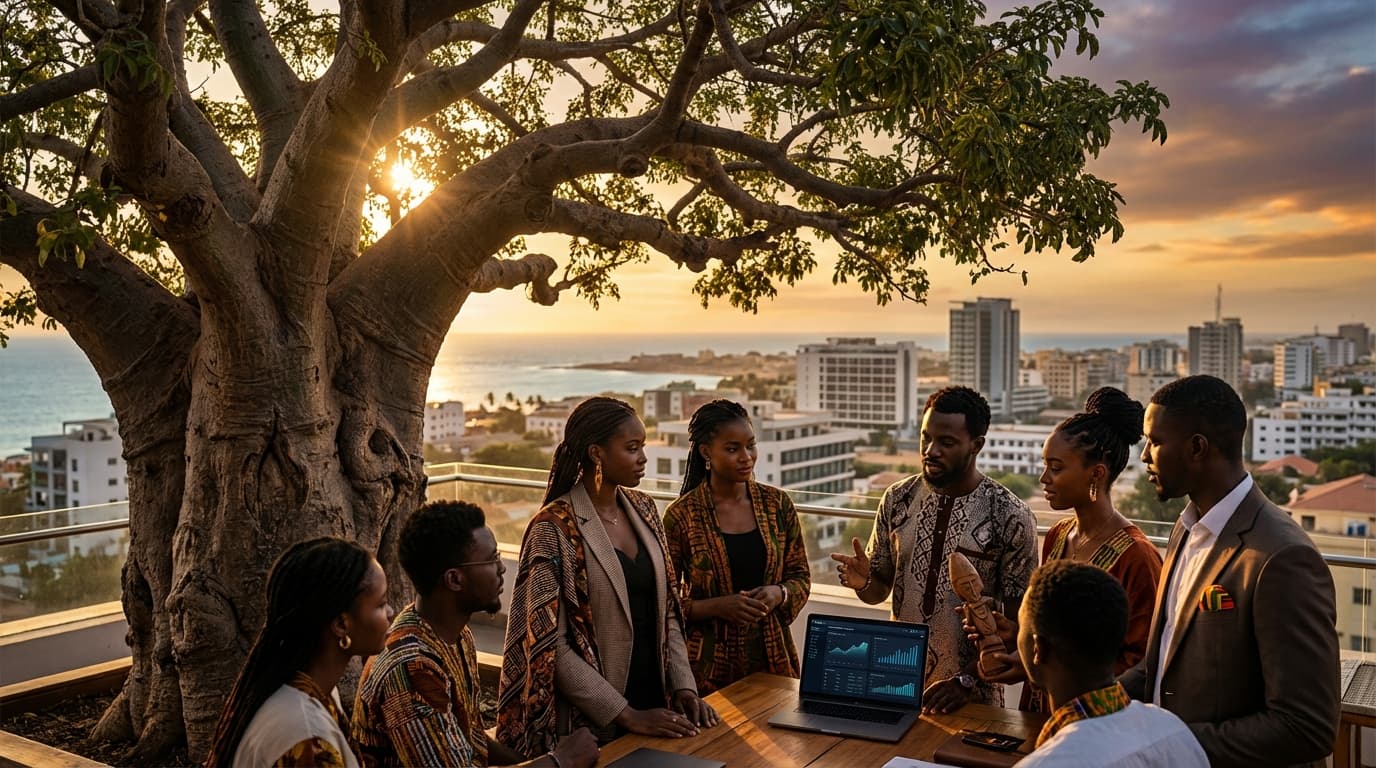
In the shade of a century-old baobab tree on Dakar's corniche, a young Senegalese entrepreneur shares his vision. He doesn't speak of venture capital or tech unicorns, but of patience. "The baobab doesn't grow quickly," he says, "but once rooted, nothing can bring it down." This botanical metaphor alone captures the philosophy of contemporary African success: an excellence that flourishes not in colonial urgency, but in cultural depth. Across the continent and throughout the diaspora, Black women and men are reinventing the rules of economic, educational, and social engagement—not by imitating foreign models, but by drawing from the inexhaustible reservoir of their heritage. Consider Aissatou, an engineer trained in Paris who chose to return to Thiès to create a millet processing company. Her innovation? Combining traditional cereal preservation knowledge with modern vacuum packaging techniques. "My grandmother knew how to keep millet intact for years in earthenware jars," she recounts. "I simply added a technological layer to that millennial wisdom." Her business now employs forty people and exports to three African countries. Her success rests not on a break with the past, but on an intelligent dialogue between tradition and modernity. This is the first pillar of African success: seeing our culture not as a limitation, but as an accelerator. This approach manifests with particular strength in the financial realm. In Lagos, Accra, or Johannesburg, fintech platforms designed by Africans for Africans are revolutionizing banking inclusion. But look beyond the numbers: these platforms often build upon pre-existing community trust systems. Digitized tontines, for example, take the ancestral principle of collective savings and transform it into a modern investment tool. The lesson is clear: African financial literacy shouldn't be learned from Western textbooks, but developed from our historical practices of economic solidarity. Education follows the same trajectory. In Saint-Louis, a collective of teachers developed a curriculum that integrates traditional Wolof mathematics—those complex calculations used in trans-Saharan trade for centuries—with the standard syllabus. The results are spectacular: not only do students excel in calculation, but they develop a cultural pride that becomes the engine of their ambition. "When a child understands that their ancestors managed caravans of a thousand camels across the desert without computers," explains one teacher, "they begin to see unlimited potential in themselves." Resilience, that quality so often attributed to Africans, takes on a strategic dimension here. It's not merely about enduring difficulties, but transforming them into creative opportunities. Consider those Egyptian startups that, during the Aswan bootcamp, raised millions by relying on local networks rather than foreign investors. Their strength? An intimate understanding of their community's specific needs, and the ability to address them with adapted rather than imported solutions. In the diaspora, this philosophy takes different but equally powerful forms. In Montreal, Toronto, or London, Black professionals create mentorship circles that function like modern extended families. Every individual success is celebrated as a collective victory, and every challenge is faced with group support. "We've recreated the village in the metropolis," explains a Senegalese lawyer based in New York. "When one of us gets a promotion, we organize a celebratory *thieboudienne*. The food connects our present achievements to our deep identity." The mindset of African success in the 21st century thus rests on three interconnected pillars: cultural rootedness as a source of innovation, community as a support ecosystem, and the baobab's strategic patience as an antidote to imposed haste. This isn't about denying challenges—economic, political, social—but about addressing them with tools forged in our own history. The entrepreneur transforming cassava into value-added products in Nigeria isn't just creating a business; they're rehabilitating a food culture and creating local wealth. The engineer developing a mobile payment application in Kenya isn't just doing technology; they're modernizing ancestral commercial practices. Under Dakar's baobab, the entrepreneur concludes our conversation by pointing to the tree's visible roots. "Look how strong they are, deep, interconnected. Our success should resemble this: firmly anchored in who we are, nourished by the wisdom of those who came before us, and always oriented toward elevating those around us." This is the true face of African excellence: not a solitary race to the top, but a slow and powerful collective growth, in the benevolent shade of our roots.