
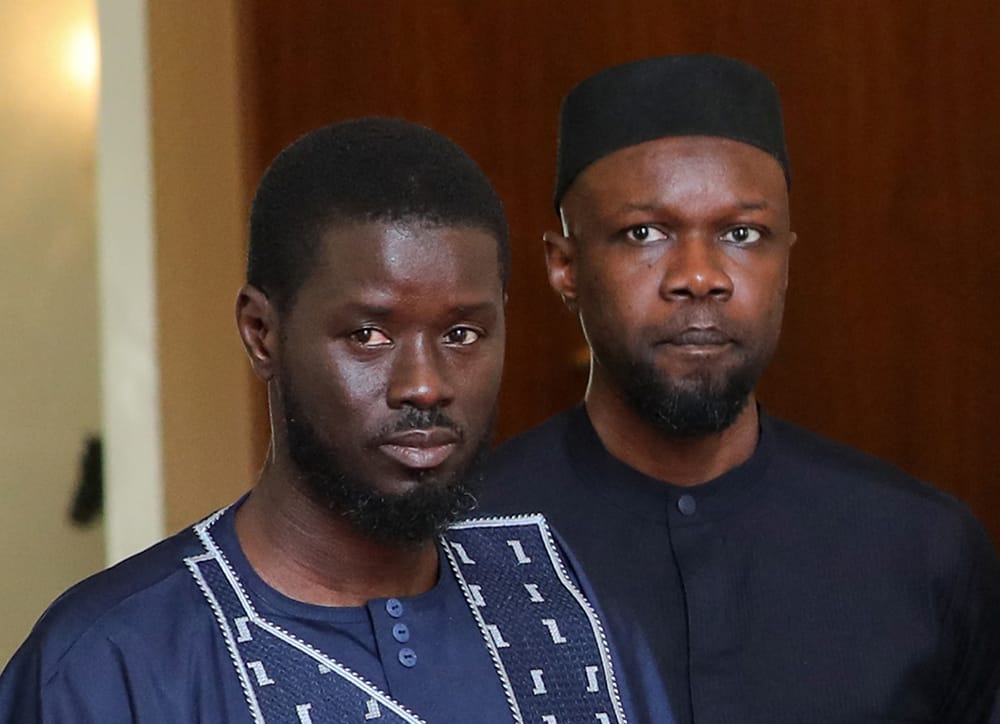
The Killing of the Father: Sonko vs. Diomaye
The article analyzes the political "parricide" of Ousmane Sonko by President Diomaye Faye, arguing Faye cannot inherit Sonko's popular charisma. After dismissing Sonko as prime minister, Sonko was elected President of the National Assembly, illustrating that the symbolic father rises again, leaving the son truly alone.
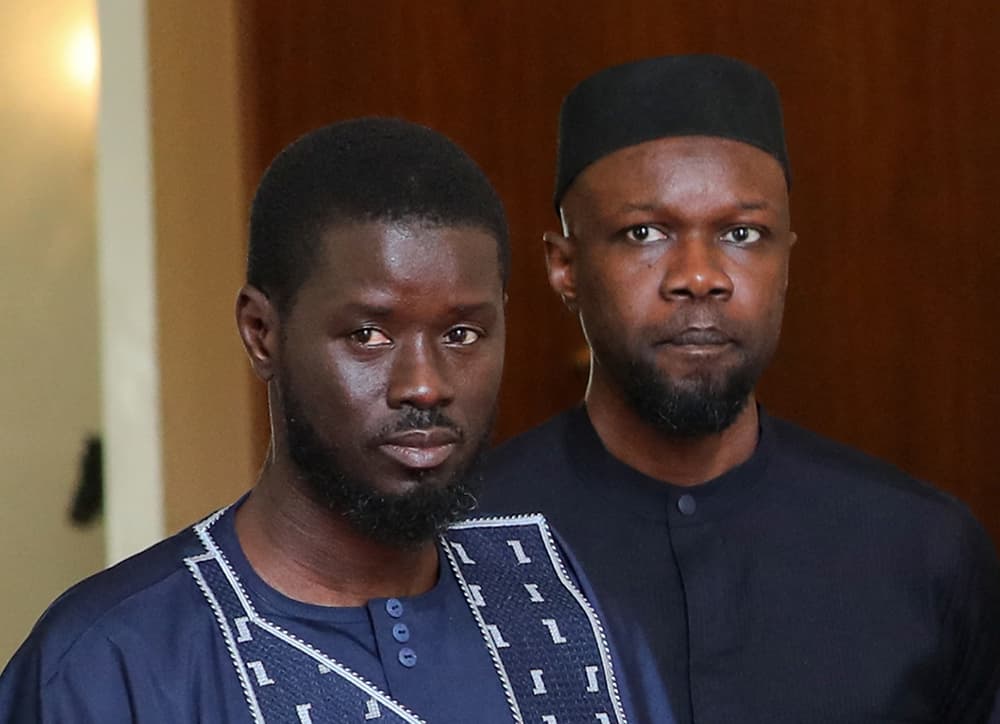
This, perhaps, is the true curse of political parricide: the father dies institutionally, but rises again symbolically. And the son who thought he was freeing himself finds himself, for the first time, truly alone.
From Parricide Foretold to Its Accomplishment — Reflections on the Faye–Sonko Rupture
On May 22, 2026, a presidential decree ended the duties of Prime Minister Ousmane Sonko. For anyone who had read the signs, the act came as no surprise. It was the logical culmination of a dynamic that some — including the author of these lines — had tried to name in these very columns: institutional parricide. This text is its sequel — not an indictment, but a political autopsy.
From Metaphor to Act: The Parricide Accomplished
A few months ago, I wrote in these same columns that the Faye–Sonko relationship carried within it the seeds of an institutional parricide. I used the word then with the caution of the metaphor-maker — one who names a structure without prejudging its outcome. That outcome has now arrived, and it calls for a rereading.
Parricide, in the political sense that Freud gave it in Totem and Taboo, is not an act of hatred. It is an act of foundation. The son kills the father not to destroy him, but to take his place — to become, in his turn, the group's center of gravity. What makes the Senegalese case singular is that the institutional son — Diomaye Faye, raised politically by Sonko, freed from prison by the popular pressure Sonko had generated, elected thanks to Sonko's charisma — sought to emancipate himself from a father still living, still present, still heard.
And yet, parricide is legitimate, in Freudian logic as in political logic, only when the father has exhausted his legitimacy. Here, the father was not exhausted. He was cumbersome. A decisive nuance.
One does not kill with impunity the one from whom one's legitimacy is drawn.
The Vassal's Rebellion — What Machiavelli Understood
Machiavelli, in The Prince, distinguishes two kinds of counselors dangerous to the sovereign: the one who is too weak to be useful, and the one who is too strong to be controlled. Sonko belonged, without ambiguity, to the second category.
The Faye–Sonko relationship reproduced a classic Machiavellian pattern: the prince rises to power carried by a lieutenant whose popular base is larger than his own. For a time, this asymmetry is bearable — even useful. It becomes intolerable the moment the prince seeks to govern alone, to build his own political identity, to extract himself from the tutelary shadow.
This is precisely the moment we have lived through since the autumn of 2025. The signals were accumulating: dismissals of Sonko's allies within the presidential apparatus, a progressive rhetorical distancing, consultations with former prime ministers and unaffiliated technocrats. Diomaye Faye was seeking to build a court that belonged to him — a court emancipated from Sonkist Pastef.
But Machiavelli also warned the prince against a fatal error: believing that a vassal grown too powerful can be neutralized by a mere administrative act. The decree of May 22, 2026 ended the functions of the Prime Minister. It did not end Ousmane Sonko.
"The prince who fears his minister fears himself. And he is right to fear." — Machiavelli, The Prince, Chapter XXII
The Curse of Inherited Charisma
It is here, in my view, that the tragic knot of this rupture lies — and the painful discovery that awaits Bassirou Diomaye Faye in the coming months.
Max Weber distinguished three forms of political legitimacy: legal-rational legitimacy, founded on institutions; traditional legitimacy, founded on heritage; and charismatic legitimacy, founded on the direct, almost mystical relationship between a leader and his people. This last form is the most powerful — and the only one that is strictly non-transmissible.
Ousmane Sonko possesses charisma in the Weberian sense of the term. He built it in resistance, in prison, in judicial persecution, in rallies where his mere presence was enough to transform a crowd into a people. This charisma was not constituted in palaces; it was constituted in the street, in shared suffering, in the collective sense of a community of destiny.
Diomaye Faye, for his part, came to power through the delegation of that charisma. The Senegalese people voted for him because Sonko had told them to — because "Diomaye moy Sonko." That delegation is a considerable political resource upon taking office. It becomes a structural handicap the moment one tries to break free of it.
For the people have not forgotten. And the people know how to tell the difference between the one who was designated for them and the one who conquered them. Diomaye Faye can govern. He can even govern well. But he cannot inherit the charismatic bond between Sonko and the Senegalese people. That bond is personal, inalienable, and it survives every decree.
"Charisma cannot be decreed. It is won in resistance, or it is not won at all."
What History Will Remember
I am not a judge of men. I am an observer of dynamics. And what I observe tonight is a pivotal moment in Senegal's post-independence political history.
For the first time since Léopold Sédar Senghor, a Senegalese political leader possesses a popular anchoring that transcends parties, regions, and generations. That anchoring was not given to him by an election; it was granted to him by a people who suffered with him, who believed in him when the entire system sought to crush him.
The decree of May 22, 2026 does not change this reality. It radicalizes it. For in the collective memory of peoples, nothing consolidates a leader's stature more than the injustice he endures. Mandela emerging from Robben Island. Lula emerging from prison to win the Brazilian presidency. History has its laws, and they cannot be negotiated by decree.
Bassirou Diomaye Faye has exercised his constitutional right. No one disputes this. But he will henceforth have to govern without the support of the man who lent him his legitimacy, and before a people who, for their part, did not sign this divorce.
This, perhaps, is the true curse of political parricide: the father dies institutionally, but rises again symbolically. And the son who thought he was freeing himself finds himself, for the first time, truly alone.
"Great political figures do not die by decree. They die — or are reborn — in the judgment of the people."
The Return of the Repressed — An Unexpected Epilogue
This article was written. It was about to be published. And then history, with its sovereign irony, decided to write its own ending.
In the hours that followed the dismissal decree, El Malick Ndiaye, President of the National Assembly and a man of the same camp, resigned from his post. Ousmane Sonko returned to his seat as a deputy in the National Assembly to be elected, in the same breath, President of the National Assembly of Senegal.
Let us pause a moment to measure what this means — constitutionally, politically, symbolically.
Constitutionally: the President of the National Assembly is, under Senegalese law, the second-ranking figure of the State. In the event of a vacancy in the presidency, it is he who assumes the interim. Diomaye Faye dismissed his Prime Minister in the morning. By evening, that same man had become his designated constitutional successor.
Politically: Sonko no longer governs from the Prime Minister's Office — he now controls the legislative power. He can summon the government, steer budget debates, weigh on every appointment, every law, every reform. The dismissal, meant to remove him from the game, has placed him back at the heart of the chessboard, on a square that Diomaye Faye cannot take away from him by decree.
Symbolically: it is the return of the repressed in the most literal sense. Political psychoanalysis teaches us that what one seeks to suppress by force always returns — often in a more powerful form, more legitimate, harder to contain. Freud called this the return of the repressed. Machiavelli would simply have called it a miscalculation.
El Malick Ndiaye resigned from the presidency of the National Assembly. This gesture, discreet in appearance, is in reality a political act of rare elegance — the act of a man who chooses his camp at the moment when choosing costs something. He deserves to be saluted.
As for Bassirou Diomaye Faye, he finds himself in the most uncomfortable situation a head of state can experience: governing under the institutional gaze of the very man he sought to be rid of. Each Council of Ministers, each address to the nation, each act of government will henceforth unfold under the eye of the President of the National Assembly — an eye that knows every file, every promise, every renunciation.
Greek tragedy had a name for this situation: Nemesis. The immanent justice that catches up with the one who believed he could free himself from the order of things.
The institutional parricide has been accomplished. But the father, for his part, presides over the National Assembly.
"You think you have killed the lion. You have only offered him a gilded cage from which he watches — and waits."
If political heirs often become haunted by the very figures they overthrow, how can African movements truly break cycles of authoritarian legacy without falling into symbolic reincarnation?
