
Narratives

The Weight of Unspoken Promises: How Parental Expectations Drowned Moussa's Dreams

Moussa Diop sacrificed his health and happiness in Toronto to meet his family's financial demands in Senegal, driven by cultural guilt. After years of sending money, he died from a heart attack upon learning his family faked a medical emergency to extract more funds.
SunulifeFri, Mar 20, 202610min read
The Weight of Unspoken Promises: How Parental Expectations Drowned Moussa's Dreams

Moussa Diop had always believed that leaving Senegal would be his salvation. At twenty-four, with nothing but a battered suitcase, a student visa scraped together through sheer persistence, and the weight of his family’s dreams pressing on his shoulders like the humid Dakar air he left behind, he boarded a plane bound for Toronto. “I will make you proud,” he whispered into his mother’s ear at the airport, her tears soaking his collar. His father, a retired teacher whose pension barely covered rice and fish, had gripped his son’s hand with surprising strength. “You are our light now, Moussa. God chose you for this. Do not forget us.”

The first years in Canada were a brutal baptism. Moussa worked two jobs: days stacking boxes in a Mississauga warehouse where the cold bit through his thin jacket, nights driving for Uber, eyes burning from the glow of the dashboard clock that never seemed to rest. He lived in a basement apartment shared with three other Senegalese men, the walls thin enough to hear every prayer call from someone’s phone at dawn. Yet every Friday, without fail, he wired money home. Two hundred dollars. Three hundred. Sometimes four hundred when his sister Aïssatou needed school fees or his little brother Ibrahima’s football cleats tore beyond repair. “It is nothing,” he told his mother on the crackling WhatsApp calls. “I am fine. Eat well, Maman.”

But fine was a lie that grew heavier with every passing season.

The calls began innocently enough. “How are you, my son?” his mother would ask, her voice soft as the evening call to prayer. Then, within minutes, the shift: “Your father’s back hurts again. The doctor says he needs medicine we cannot afford. And your cousin Fatou’s wedding is next month. God forbid we shame the family by sending her empty-handed.” Moussa’s chest would tighten. He pictured his mother on the plastic chair outside their cement-block house in Pikine, fanning herself with a newspaper while the neighbors listened. He always sent more. How could he not? She had carried him on her back through the market as a child. She had gone without food so he could eat.

Religion became the sharpest blade. “The Prophet, peace be upon him, said paradise lies at the feet of mothers,” she would remind him, quoting verses he had memorized as a boy. “Will you abandon me and risk God’s wrath? Your father sacrificed everything for your education. Do not let the devil make you selfish in that cold country.” Moussa would hang up, forehead pressed against the steering wheel in some empty Toronto parking lot, whispering his own prayers for forgiveness. He began to dread the green notification light on his phone. Each ring felt like judgment.

The family network tightened like a noose. Aunt Mariama in Rufisque would call next: “Your mother cries every night, Moussa. She says you have forgotten the taste of thiéboudienne she cooked for you.” Uncle Babacar, the loudest voice at family gatherings, would forward group messages: “The son in Canada cannot even help with his uncle’s hospital bill? What kind of man are you becoming?” His siblings joined in, innocent at first, then resentful. “We hear you have a car now,” Ibrahima texted once. “Yet we walk in the dust.” Moussa sold the second-hand Honda he had scraped together after eighteen months of saving. The money went home. The car had been his dream of independence; now it was just another ghost.

Years blurred. Moussa turned thirty, then thirty-two. His body ached constantly: shoulders knotted from lifting, knees swollen from standing. He met Fatou, a gentle Wolof woman working at a daycare in Scarborough, and for the first time imagined a life that was his own: a small wedding, a one-bedroom apartment, maybe a child who would speak both French and English without shame. But when he mentioned marriage to his mother, the response was swift and devastating. “A wedding here first, my son. Your sisters must marry before you. And we need to build the extra room so your wife can visit. God will not bless a union built on selfishness.” He sent the money for the room. Fatou waited another year, then another. Eventually she stopped waiting. “I cannot marry a man whose entire paycheck already belongs to ghosts,” she said quietly one rainy evening, her suitcase by the door. Moussa watched her leave, the sound of the closing door echoing like a final call to prayer he could no longer answer.

He tried, once, to set boundaries. After reading late-night articles about immigrant burnout in diaspora forums, he rehearsed the words. “Maman, I love you, but I can only send two hundred dollars a month now. I need to save for my future so I can help you better later.” The silence on the line was thunder. Then the storm: “So this is what Canada has done to you? Turned you into a white man who counts his coins while his mother starves? Your father is dying, and you speak of limits? May God forgive you.” The entire family WhatsApp group lit up with messages, some angry, some pitying, all accusing. “You have changed,” they wrote. “The village is ashamed.” Moussa caved. He sent five hundred that month, borrowing from a payday lender whose interest rates felt like chains around his neck.

The guilt of absence gnawed deepest during holidays. Eid came and went without him. His father’s seventieth birthday passed with only a video call where the old man stared into the camera and said, “I may not live to see you again, son. But at least your money keeps us alive.” Moussa booked a ticket home once, draining his emergency fund. He arrived bearing suitcases of clothes, phones, and perfumes, only to be greeted with new demands: “Your cousin needs surgery. The plane fare for your sister’s fiancé. Help us buy land before prices rise.” He returned to Toronto broke again, the taste of his mother’s jollof rice now bitter on his tongue.

By thirty-five, Moussa was a shell. His savings account showed $187. His credit cards were maxed. Sleep came in fragments haunted by ringing phones. He had started therapy through a free immigrant clinic, a soft-spoken counselor who understood the cultural weight. “You are allowed to love them differently,” she said. He joined a Senegalese men’s support group in a church basement near Jane and Finch, where men with the same haunted eyes shared stories that mirrored his own. For three months he held firm: fixed transfers, honest conversations, small non-monetary gifts like voice notes of him singing old songs. His mother’s tone grew colder. “You sound like a stranger now.”

Then came the night that shattered everything.

It was a brutal February evening, snow whipping against the windows of his new basement room. The phone rang at 2:14 a.m. His mother’s voice, trembling: “Your father collapsed. The doctor says it is his heart. He keeps calling your name. We need ten thousand dollars for the operation tomorrow or he dies. Please, Moussa. God is watching.” Panic clawed his throat. He had just received a small promotion, enough for a down payment on a modest condo, enough to finally breathe. But his father’s face swam before him, the man who had sold his only watch so Moussa could buy schoolbooks. With shaking hands, Moussa transferred every cent: his savings, his emergency fund, even the last of his credit limit. He booked the next flight home, heart pounding with fear and something darker: relief that he could finally prove his love.

He arrived in Dakar at dawn, eyes sunken, body trembling from exhaustion and the weight of two sleepless nights. The family was gathered outside the hospital, not in mourning, but laughing. His father sat upright in bed, eating couscous, color in his cheeks. The “emergency” had been exaggerated: an old man’s chest pain eased by rest and cheap pills. “We thought you would come faster if we said it was serious,” his mother admitted, eyes averted. “You stopped sending enough. We were scared you had truly forgotten us.”

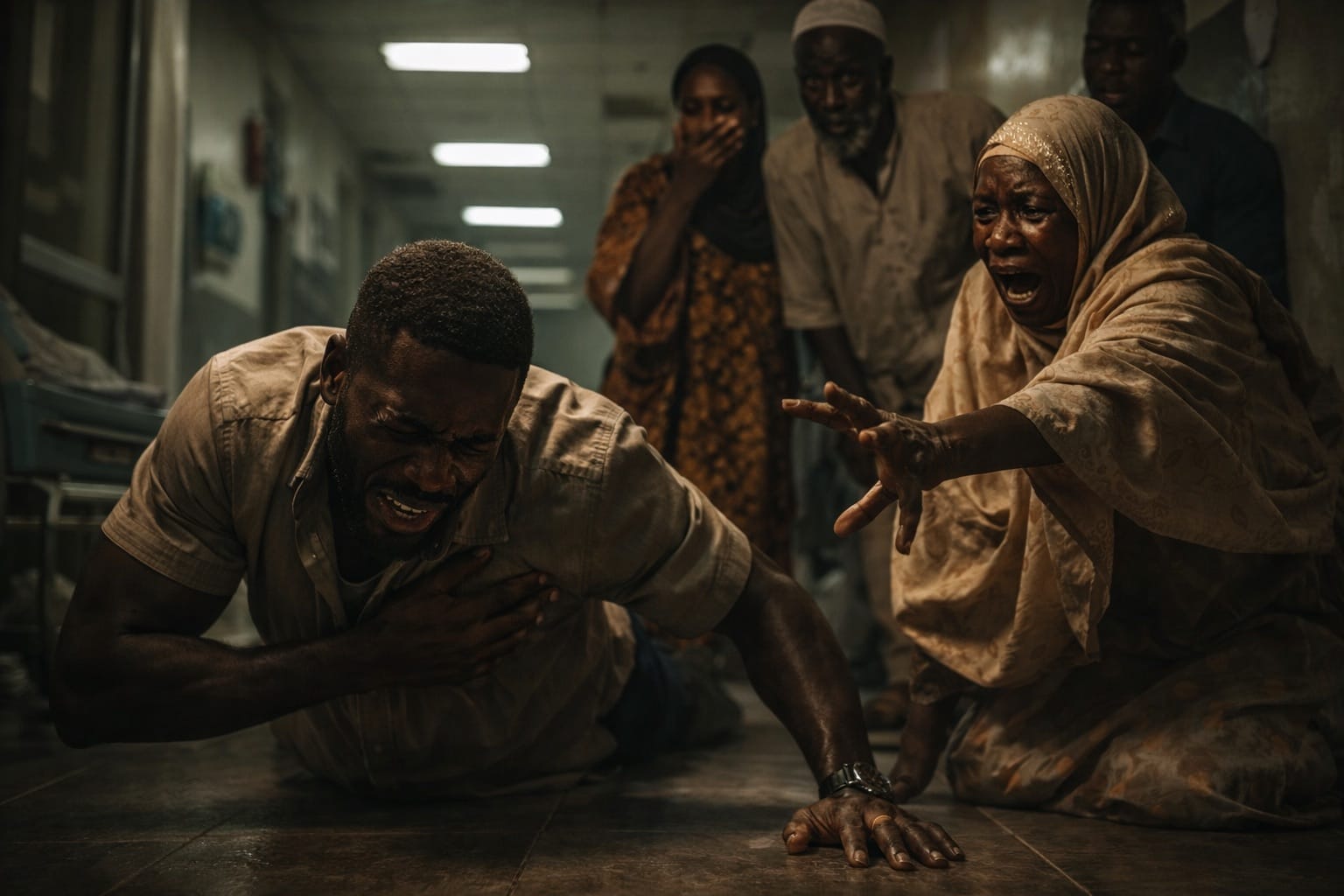
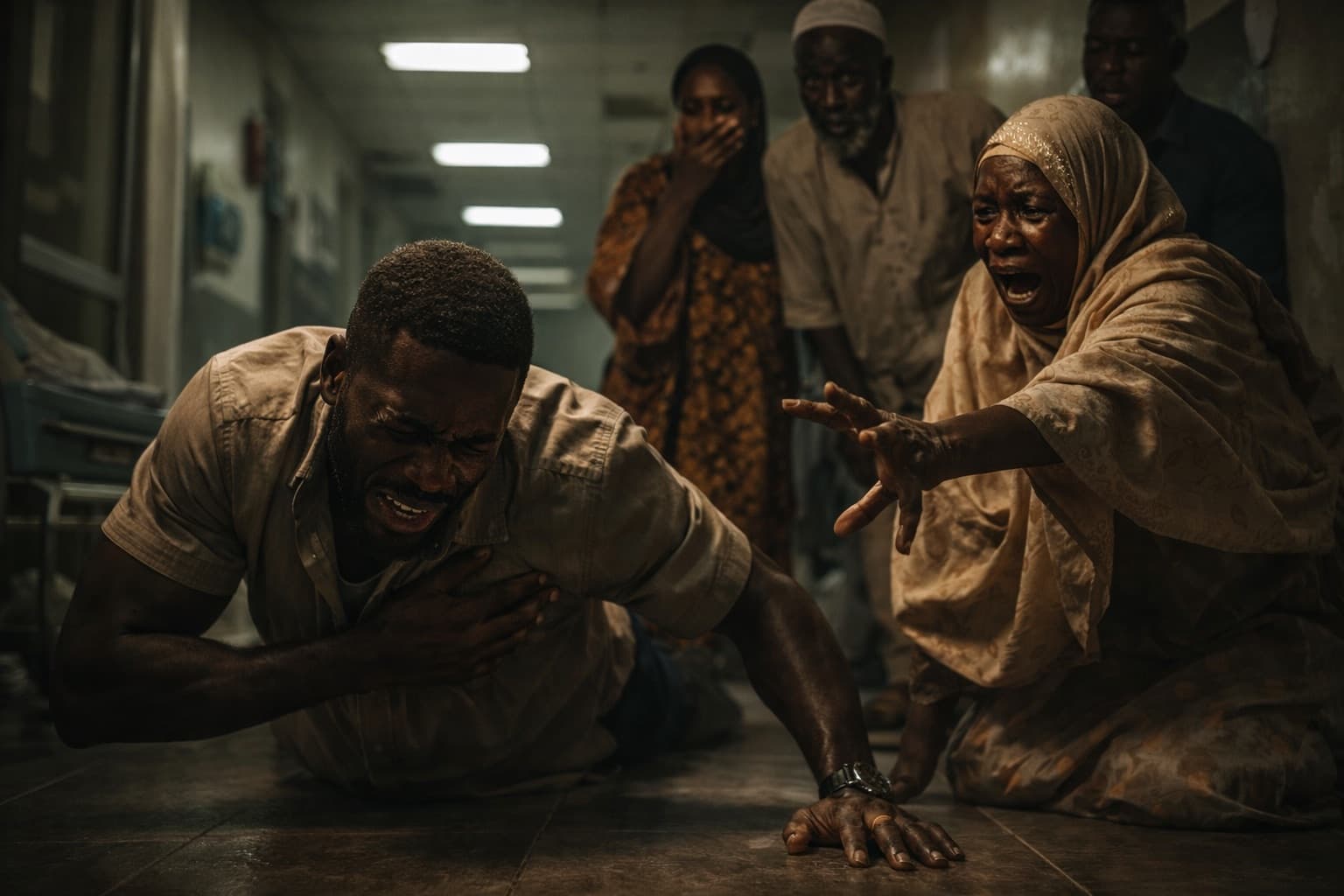
The room spun. Moussa felt something inside him snap like a rusted chain. He stood there in the hospital corridor, the fluorescent lights buzzing like accusations, and for the first time in twelve years he raised his voice. “I have given you everything! My youth, my health, my future! I have no wife, no home, no peace, only this!” The family stared, shocked into silence. His mother began to cry. His father reached out a trembling hand. But Moussa could no longer see them clearly. His chest tightened, breath shallow. He staggered backward, the world tilting. The last thing he remembered was the cold tile floor rushing up to meet him and his mother’s scream echoing off the walls: “My son! What have we done?”

Moussa Diop died that afternoon from a massive heart attack brought on by years of unrelenting stress, hypertension, and a body pushed beyond its limits. He was thirty-five years old. At his funeral in Pikine, the same family that had drained him stood weeping over his coffin, clutching the very phone he had bought them. Neighbors whispered that the son from Canada had come home only to leave forever. His mother, veiled in black, clutched a small notebook where Moussa had once listed his dreams: buying land, opening a shop, raising children who would never know this pain. She read it silently, tears falling on the pages, and for the first time understood the weight she had placed on her only light.

The lessons that must be learned from Moussa’s tragic story are harsh but necessary, for they echo across every immigrant community carrying the same invisible chains:

  • Expectations must be educated on both sides. Families left behind must hear the unfiltered truth of foreign costs, taxes, isolation, and the daily fight for survival. Immigrants must stop softening reality out of fear. Honest dialogue, painful as it is, is the only bridge that does not collapse under lies.
  • Limits are not betrayal; they are survival. A fixed, sustainable amount sent monthly, with clear communication, protects everyone. Saying “I cannot” is not selfishness; it is the only way to remain strong enough to help long-term. Culture must evolve, or it will bury its own children.
  • Community support is not optional. No one should carry this alone. Diaspora groups, online forums, culturally aware therapists: these are lifelines. Isolation turns guilt into poison; shared stories turn it into strength.
  • Love must be shown differently. Money is not the only currency of affection. Regular calls, recorded messages, prayers, small thoughtful gifts: these sustain bonds without financial ruin. True love wants the giver to thrive, not drown.
  • The hardest truth: Good intentions do not erase destruction. Parents may believe they act from love, but unchecked pressure kills dreams and bodies. Immigrants must choose themselves without guilt, because no one else will. To break the cycle, one must sometimes risk being called ungrateful, otherwise, the grave becomes the only place where the expectations finally stop.

Moussa’s light was extinguished too soon. Let his story be the warning that saves the next generation from the same quiet, devastating flood.