
The Weight of Plenty: What the West Calls Poverty, We Call Peace
This story contrasts two lives: Ousmane, a Senegalese farmer with community and time sovereignty, and Ethan, a wealthy but isolated American professional. It suggests true wealth lies in connection and agency, not material possessions.
Two men rise with the same sun. One owns almost nothing. One owns almost everything. Only one of them is rich.
The Morning Ritual
Senegal — The Village
Ousmane does not need an alarm. The village wakes him — the low percussion of a pestle against a wooden mortar, the answering crow of a rooster, the first call to prayer dissolving into cool air that still smells of earth and last night's cook-fire. He rises from his mat in a single unhurried movement, the way a man rises who has nowhere to be at a precise number of minutes and nowhere to go that does not already belong to him.
The walk to the well takes twelve minutes. He knows because he has walked it ten thousand times, and yet he does not count. On this morning he greets Modou, the weaver's eldest son, who is carrying water on a shoulder-yoke and laughing about something his wife said at dawn. He greets the three sisters who have been collecting firewood since before sunrise, already arguing cheerfully about who will cook and who will refuse to. He greets the old man Babacar, who sits at the same stone every morning to watch the light change over the millet field, and who offers nothing more than a nod that contains, somehow, a complete philosophy.
By the time Ousmane reaches the well his chest has filled with something that has no name in any economic index. He has spoken to five people. He has laughed twice. He has been seen — truly seen, by people who have known his face since it was a child's face — before the sun has fully cleared the horizon. He carries his water home and does not once think about what he does not have.
United States — The City
Ethan's alarm is the sound of a marimba recorded in a studio in California, compressed into an MP3, stored on a server farm in Nevada, and now erupting from a device worth more than Ousmane's annual income. He silences it with a violence of his thumb. He lies still for exactly thirty-seven seconds — he has timed this, because he read an article that said lying still for thirty seconds before rising reduces cortisol — and he stares at a ceiling that cost two hundred and forty dollars per square foot to install above him.
His apartment is a portfolio of considered purchases. Pour-over coffee equipment from a company in Portland. A mattress engineered for spinal alignment. A sound machine producing the noise of rain for a man who lives in a city that gets considerable actual rain, which he does not hear because his windows are triple-glazed for insulation and because he runs the sound machine to cancel the noise of sirens that pass twice an hour on the avenue below. He grinds his coffee. He watches the grounds bloom in the bloom-water. He drinks it standing at the kitchen counter — no table, because the apartment is a studio and he works too many hours to justify a table — while reading, on the same device that woke him, a push notification about a shooting four blocks north of where he stands.
He has not spoken to anyone. He will not speak to anyone for forty-five more minutes, when he says good morning to the woman at the building's front desk, and she says it back, and both of them mean almost nothing by it. He is thirty-one years old, connected to six hundred and twelve people on a social network, and he is, in this moment, completely alone.
The Meaning of Work
Senegal — The Village
The work is hard. This must be said plainly, without romanticism. The sun in the dry season is a physical force. The hoe handle raises blisters on blisters. There are mornings when the back does not want to bend and the field does not seem to end and the yield is not certain. The work is hard.
And yet. Ousmane works his own soil. The grammar of that sentence should be felt: his own soil, the dirt of an inheritance, the ground where his grandfather is buried, the ground he will give his sons. When his hoe strikes the earth he is not producing a unit of output that will be assigned a value by a market he does not control. He is feeding his family. The connection between effort and meaning is a straight, unbroken line. No manager interprets his labor. No quarterly review renders a judgment on it. The millet either grows or it does not, and the weather is honest about its reasons.
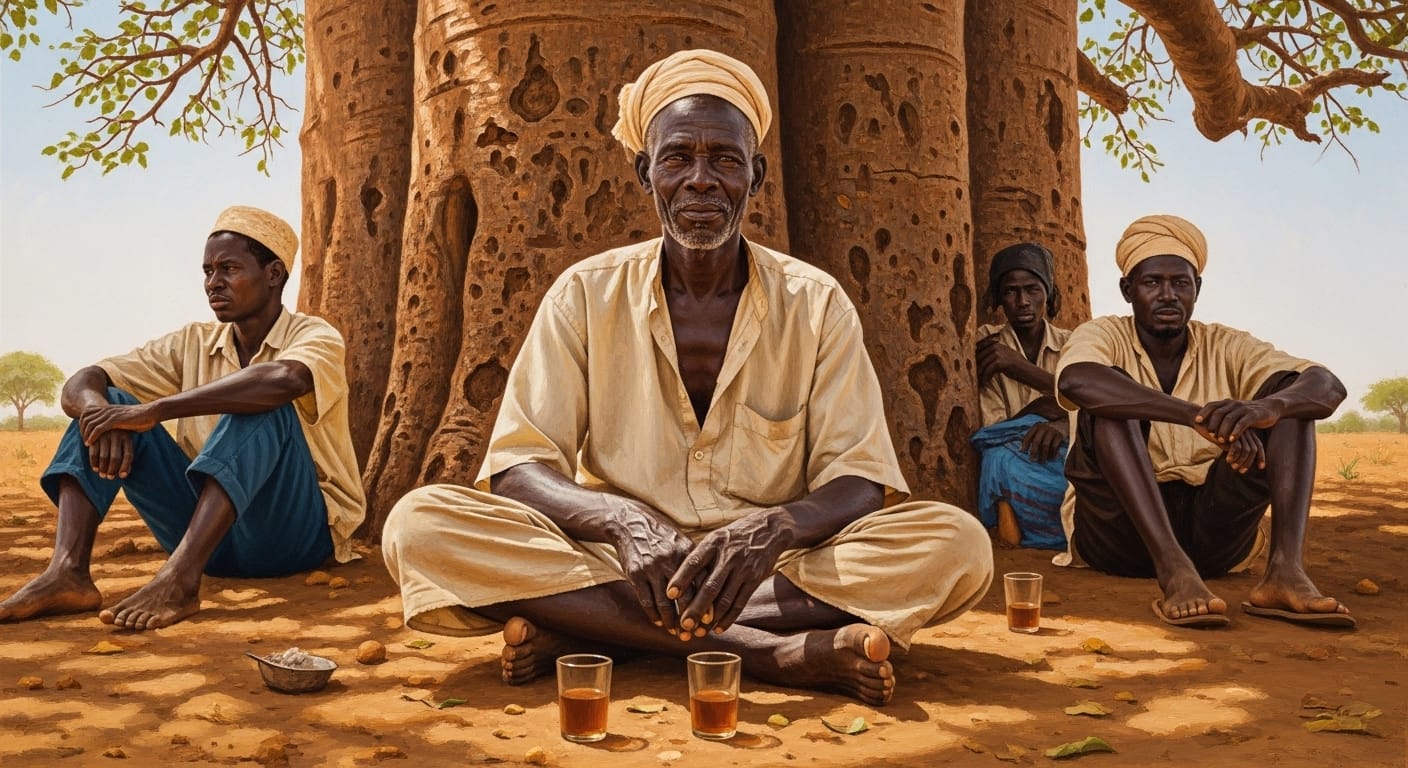
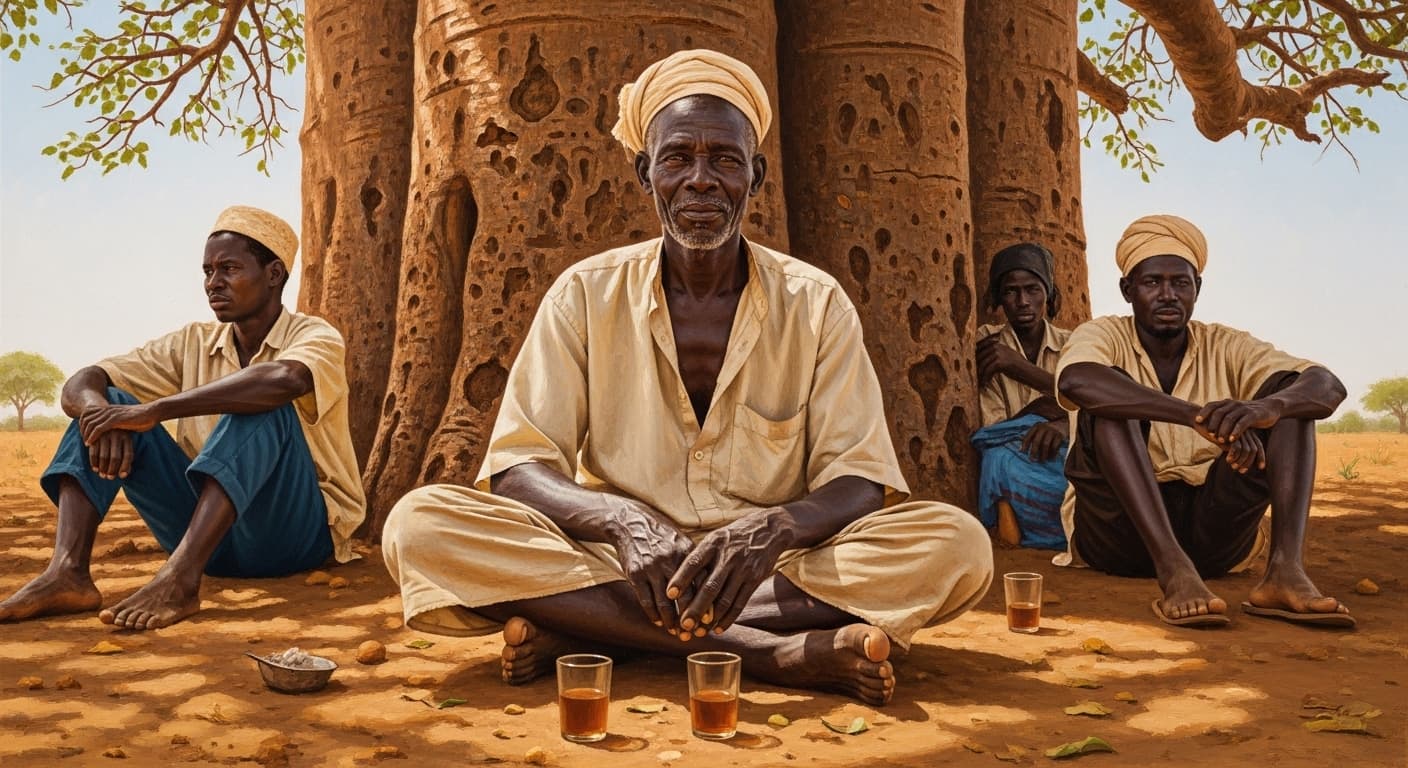
At mid-morning his brothers come. They work the far rows with the easy competition of men who grew up running together. They curse the sun in a way that is also a kind of prayer. When the light becomes impossible — when it flattens everything to white — they move to the shade of the old baobab at the field's edge, the tree so large and old it seems geological rather than botanical, and they sit and drink attaya in three rounds of increasing sweetness and talk about nothing that matters and everything that does. They have nothing in their pockets. The GDP of this moment is zero. And Ousmane's heart, in this moment, is the quietest thing he owns.
United States — The City
The office is seventy-one degrees. A building management system has decided that seventy-one degrees is the correct temperature for productivity, and so the air is held at seventy-one degrees whether it is January or July, whether Ethan is hot or cold, whether the humans inside the building are comfortable or not. The building does not ask. Ethan does not ask. This is called efficiency.
He makes, in an hour, what Ousmane makes in a month. This figure is used, in the conversations of economists and development workers, as evidence of something — usually of Ousmane's poverty and Ethan's success. What the figure does not capture is the texture of Ethan's hour. The email from his manager asking for the revised projections before end of day, a phrase which, in this office, means before 8 PM. The performance review cycle that produces, every six months, a document rendering numerical judgment on his human worth. The awareness — permanent, low-grade, like a sound just below hearing — that the company retains him at will, that his salary is a subscription the company can cancel, that his very presence in this building is contingent on his continued usefulness to people who do not know his middle name.
He is connected. His phone pushes notifications from seven different applications designed to keep him informed and available. He is, at all hours, reachable. He has no baobab tree. He has a glass-walled conference room where people perform the ritual of collaboration while actually, each of them, performing a private calculation of risk. He has colleagues, not brothers. He is not hungry. He is not, in any technical sense, suffering. He is simply — and this is the word he uses when he speaks to his therapist on Thursdays — invisible.
Interlude: The Philosophy of Safety
"They have enough bombs to end the world. And still, he does not feel safe walking to his car."
There is a certain kind of safety that nations purchase with aircraft carriers and intercontinental missiles and satellite surveillance systems that can read the text on a license plate from low orbit. Ethan's country has all of these things. It has, by the accounting of military historians, never been more defended. And yet the violence that Ethan fears — the random, purposeless, grinding violence of a city that has stopped being able to hold its people — is not the kind that aircraft carriers prevent. No missile can intercept the hopelessness that moves through a neighborhood like weather. No surveillance satellite can surveil the interior of a soul.
In the village, they discuss the outside world in terms that the outside world would find presumptuous. They know the system — the one that calls itself development, that arrives with NGO vehicles and clipboards and the particular expression of charitable concern — wants something. The land holds minerals. The coast holds fish. The region holds strategic position. They have been taught, by centuries of instruction they did not request, what happens to people who open the door when the development workers knock.
And so their sovereignty — their right to say no — is not stubbornness or ignorance. It is the most sophisticated calculation they make. They have looked at what the Western world sells as "the good life" and they have counted its casualties, and they have decided that their peace is worth more than the Western world's supermarkets. Their shield is not nuclear. It is cultural. And it holds.
The Breaking Point
United States — The City
It happens on a Tuesday, which is to say it happens on a day no different from any other day, which is the point. A man Ethan has never met walks into a pharmacy three blocks from his apartment and does something terrible for reasons that will later be explained in a press conference and a psychiatric evaluation and a thousand op-eds, and still the reasons will not quite add up to a reason. The city responds with the machinery it has for these occasions: police tape, helicopters, a vigil with candles in paper cups, a hashtag, a week of debate about what it means, and then — quiet. The ordinary machinery of the city reasserts itself. The pharmacy reopens.
Ethan watches the coverage on his phone. He feels what he is supposed to feel — grief, anger, the specific helplessness of a citizen who has no mechanism for his outrage — and then he goes to work, because the deadlines do not have feelings about what happened on Tuesday. He tells his therapist about it on Thursday. His therapist says that sounds incredibly difficult, and Ethan agrees that it does, and the session costs two hundred and twenty dollars, and afterward he sits in his car in the parking structure for nine minutes without starting it, looking at nothing.
The advanced society has no answer for why the man walked into the pharmacy. It has explanations — economic, psychological, political, pharmaceutical, sociological. The explanations are very sophisticated. And the man walked into the pharmacy, and will walk into pharmacies, and the explanations do not prevent this.
Senegal — The Village
The drought comes. This is not a metaphor. The rains do not arrive when they are supposed to arrive, and then they do not arrive at all, and the millet bends and thins in ways that Ousmane and his father and his grandfather can all read like a text they have studied together across generations. The reading says: this will be a hard year. The reading does not say: this will destroy us.
The village does what the village has always done. The granary is opened with a ceremony that is also a renegotiation: what each family has, it shares according to what each family needs. There is an argument, because there is always an argument, about how the sharing is calculated, and the argument is conducted loudly and with great passion and then is settled, and the grain is distributed. No one family eats while another family starves. This is not a policy. It is not a program administered by an NGO with a monitoring and evaluation framework. It is simply what they do, because the alternative — watching your neighbor's children go hungry — is something none of them are able to do.
There is no homelessness here. Not because there is no hardship, but because the community is the house. The safety net is made of people who know your name and your mother's name and the name of the illness that took your uncle three years ago. When a Western journalist eventually arrives to document the drought, she will write about the suffering, and the suffering is real. She will not write about the thing that Ousmane knows and cannot explain to her: that in the worst year he can remember, he has never once felt alone in it.
Interlude: The Wealth That Cannot Be Indexed
"Ousmane has time the way the sea has water. Ethan has sold his in units so small he has forgotten that he once owned it."
The economists call it a time-poverty trap: the phenomenon by which increasing income often correlates with decreasing leisure, increasing stress, and increasing reliance on purchased substitutes for things that once occurred naturally — community, purpose, peace. The economists note this. They write papers about it. Then they go back to recommending that developing nations industrialize faster.
Ousmane's time is long and layered. There is time to sit under a tree in the middle of a working day and not feel guilty about it. There is time to have a conversation that goes nowhere in particular and arrives, unexpectedly, at something essential. There is time for the slow courtship of the seasons, the patience of planting, the different patience of waiting, the satisfying completeness of harvest. He does not feel that time is against him. He is not racing it.
Ethan is racing it. He is racing it in the office and racing it in the parking structure and racing it in the grocery store, where he buys prepared meals because cooking would cost him time he does not have. He is racing it on the weekend when he does the things he is supposed to do to recover from the week. He suspects, in his quieter moments, that the race has no finish line. That there will always be more to do. That efficiency is not a destination but a treadmill. That somewhere, in the economics of the life he has been sold, something enormous has been omitted from the price.
The Reversal
Her name is Claire and she has come from an organization whose acronym is five letters and whose budget is several million dollars and whose mission statement includes the words sustainable development and poverty alleviation. She has been in-country for eleven days. She has taken photographs of the well, the millet fields, the children, the baobab tree. She has a clipboard and a tablet and an expression of compassionate professionalism that she has honed over six years of this work, and she genuinely means well — this is important to say, and it is true — she genuinely means to help.
She sits across from Ousmane in the shade of a compound wall and works through her assessment tool. She asks about access to electricity. About distance to the nearest paved road. About ownership of household assets — televisions, refrigerators, mobile phones. She records his answers in columns that will later be aggregated into a score that will appear in a report that will be read by donors in offices in Geneva and Washington and London, and the score will confirm what the donors already believe: that this village is poor, and that the village needs what the donors have to offer.
She does not ask him about the attaya ritual under the baobab tree, because there is no column for it. She does not ask about the fact that he has not once, in forty-three years, worried that his shelter might be taken from him. She does not ask about the week of the drought, when the whole village ate from the same pot, because that week does not appear on the asset inventory. She does not ask how many of his neighbors he could name, or how many of them would appear at his door if his family were sick, or whether he has ever sat in a car in a parking structure looking at nothing for nine minutes because the largeness of his own loneliness had temporarily made him unable to move.
Ousmane answers her questions with the courtesy that is his nature. He watches her as she watches him. He sees — and this is a kind of gift, to be able to see this clearly — a woman who is exhausted and does not know why. A woman who has come to the end of the world to find something she cannot name in her assessment tool, something she is looking for in these villages with their wells and their millet and their absence of paved roads, and who will not find it, and who will fly home in twelve days to an apartment in a city where she knows almost none of her neighbors. A woman who believes, with the sincere conviction of her education and her profession, that she is the one who has arrived to help.
Ousmane is not angry at her. He is not condescending. He is simply — and the quietness of this is the whole of the story — fine. He has his soil and his family and the old tree and the neighbors he has known since he had a child's face. He has a community that is a safety net made of human beings. He has sovereignty over his land and his culture and his no — the word that protects everything else. He has time the way the river has water. He does not need to be saved. He does not need to be developed. He does not need what the Western world is selling, because he has already looked at the price and read the cost in the faces of the people who can afford everything it sells.
He pours her a third round of attaya. It is sweeter than the first two, as the ritual demands. He hands it to her in a small glass. She takes it and holds it in both hands, because that is what he has shown her, and for a moment — one uncharted moment that will not appear in her report — she is still. She is quiet. She is not racing anything.
She does not know what she is feeling. Ousmane does not tell her. He only smiles, the way a man smiles who has nothing to prove and nowhere to be, and waits, with all the patience of someone who has never sold his time, for her to drink.
"He is not poor. He is the only free man in the room."
