
The Shape of the Room: The Man Who Wanted to Fit the Mold
A brilliant risk manager thrives by embracing his vibrant Senegalese identity. However, to secure a coveted promotion, his mentor advises him to suppress his cultural expression to make the traditional board comfortable, forcing Ibrahima to choose between professional success and his authentic self.
The elevator released Ibrahima Ndiaye onto the thirty-fourth floor with a soft sigh, as though reluctant to let him pass. His deep burgundy loafers struck the polished concrete in measured rhythm, each step declaring presence without apology. The Risk Management floor carried the scent of recirculated air, fading toner, and the faint artificial sweetness of “Ocean Calm,” the building’s omnipresent yet invisible fragrance.
Today he wore deep indigo. Not the safe navy, not the vanishing charcoal, not the neutral gray that allowed men to fade into boardroom backgrounds. The suit jacket was tailored sharp at the shoulders, and a silk pocket square in vivid tangerine rose like a quiet challenge. In his left ear, low and steady, Youssou N’Dour still sang softly, the rhythm of “7 Seconds” lingering in his bloodstream even after he removed the earpiece moments before stepping into sight.
His office felt like a small act of resistance. On the credenza rested yesterday’s thieboudienne from the Senegalese spot on Fulton: the rich aroma of fish, cassava, and generous scotch bonnet still rising in faint waves, the rice golden from palm oil and time. That scent cut straight through the sterile beige surrounding him. He settled into his chair, rolled his sleeves to the elbows (revealing the thin silver bracelet his grandmother had placed on him the day he left Dakar), and opened the latest risk deck.
The numbers were harsh. They always were when truth refused to hide.
At 10:07 the conference room filled: pale faces, expensive pens tapping like anxious signals, the quiet rustle of iPads already open to his slides. Ibrahima stood at the head without advancing to the first slide. He needed no prop.
“Three quarters running,” he said, voice carrying effortlessly, “and we are still carrying forty-seven million in tail exposure because Credit decided model assumptions meant hopeful guesses. Here is what that truly costs.”
His hands moved: wide, precise, alive, shaping the air as he spoke. He traced probability curves, pointed out VaR breaches, laid bare the exact damage if markets turned wrong. He named desks. He named people. Not out of malice; out of necessity. Shame cost less than another nine-figure mistake.
Across the long table, Étienne Moreau watched: silver hair, old-money calm, the faint smile of someone accustomed to watching lions pace behind glass. Younger analysts leaned forward. Cheikh, locs still fresh and tight, eyes alight with the same hunger Ibrahima once carried openly, wrote furiously, lips moving as though tasting the logic.
When Ibrahima finished, the silence felt reverent rather than uncomfortable. Even the doubters nodded. He sat, rolled his sleeves back down, and permitted himself one small, private smile. The heat of scotch bonnet still clung to his fingertips. This was triumph without self-erasure.
He had no idea the room was already learning to reshape itself around him.
The email arrived at 4:47 p.m. on a Thursday that had overstayed its welcome.
Subject: VP Risk – Final Round Discussion
From: Étienne Moreau
Ibrahima read it three times, let the grin spread slowly and wide. VP. The real table. Amina would cry happy tears when he told her tonight. Little Fatou, only six, would attend the school without the scholarship scramble. Summers that did not require rationing. Room to breathe.
He walked to Étienne’s corner office at 6:15, after most of the floor had emptied. Hallway lights had dimmed to warm gold. Étienne’s door stood open. Inside: leather-bound volumes no one opened, bay rum aftershave, the metallic trace of inherited power.
Étienne rose, handshake firm yet brief. “Ibrahima. Sit. Scotch?”
“I am fine.”
Étienne poured anyway, slid the crystal tumbler across the mahogany like a ceremonial gift. Then he leaned back and studied Ibrahima the way a jeweler examines a stone that might crack.
“Your numbers are impeccable,” Étienne began. “The board has never seen risk modeling this precise. You have saved more than most VPs ever will. That is not flattery; that is mathematics.”
Ibrahima felt the but approaching before it was spoken. The air always grew heavy at this moment.
“But the board…” Étienne let the word float, as though the board were a fragile, anxious creature. “Old money. Generations deep. They read the same three newspapers and believe diversity is an investment category. Your work does not trouble them. Your presence does.”
Ibrahima’s pulse rose. The indigo suit suddenly felt like a spotlight in darkness.
“The gestures. The directness. The colors. The energy. Compelling in an operational meeting. But here they need steady hands. Someone who will not make legacy shareholders clutch their pearls when the quarterly letter arrives. Manage perception, Ibrahima. Soften the edges. Muted palettes. Let others receive visible credit. Make them comfortable. The kingdom is yours. VP this year. Chief Risk next. Perhaps even the chair one day.”
Ibrahima stared at the melting ice in the untouched scotch. Tiny, surrendered diamonds. He could already hear Amina’s voice: They want you to erase yourself for a bigger signature line.
Étienne leaned forward, now fully in mentor mode. “I am advocating for you. Meet them halfway. You are already wiser than most.”
Ibrahima forced the smile that remained below his eyes. “I hear you, Étienne. Thank you for the honesty.”
Étienne clapped his shoulder as though they had sealed a deal. “Intelligent choice.”
Ibrahima did not pause until he reached the stairwell landing. He stood between floors, chest constricted, removed the earpiece. Youssou N’Dour returned, loyalty and royalty inside my DNA, but the rhythm felt muffled, trapped behind thick glass.
He looked at his reflection in the polished fire door. Indigo suit. Silver bracelet. The man who had just commanded a room with nothing but truth.
For the first time he wondered how much of that man they would permit to survive.
Amina met him at the kitchen island, arms folded, dish towel twisted in one hand like evidence. Fatou slept upstairs, the baby monitor glowing gentle blue between them.
He told her everything: Étienne’s careful incision, the “manage perception” formula, the promise of elevation.
She listened in silence. When he finished she allowed the quiet to settle for a long time.
“You understand what they are asking,” she said at last.
“I do.”
“They are asking you to become decor. Elegant decor. Useful decor. But decor.”
Ibrahima leaned against the counter. “It is temporary. I wear their uniform, navigate their politics, claim the seat. Then I reshape it from within. I have broken their rules my entire career. This is simply another strategy.”
Amina looked at him the way she looked when Fatou tried to hide evidence of stolen bissap on her lips. “A mask does not know when to stop being worn, Ibrahima. It takes root. One day you look in the mirror and no longer recognize the face beneath.”
He reached for her hand. She allowed it, but her fingers stayed cool.
“I am not vanishing,” he said. “I am repositioning. Tactical. Like everything we have built.”
She studied his face for a long minute. “Promise me one thing.”
“Anything.”
“When the mask begins to feel natural, when you stop noticing it is there, come home and tell me. Even if it is painful. Even if you are ashamed. Promise.”
He nodded. “I promise.”
She stepped into him then, forehead resting against his chest. He wrapped both arms around her, breathing in the shea butter she smoothed into her braids, the faint coconut oil she loved. For a moment the kitchen smelled of home instead of concession.
He told himself it would be enough.
The first Saturday he went alone to Brooks Brothers on Madison. No music in his ears. No bright pocket square. He stood beneath fluorescent light that drained every color of life and tried on navy. Then charcoal. Then medium gray so neutral it stung to see.
The salesman, white, mid-fifties, practiced deference, kept murmuring, “Very classic. Timeless. You will blend perfectly.”
Ibrahima stared into the three-way mirror. The man reflected wore a suit the color of rain-heavy clouds above the Hudson. No edges. No declaration. Invisible.
He purchased three. Paid full price so he would not need to return soon.
Monday morning he walked the floor in medium gray. No tangerine square. Sleeves buttoned. Posture corrected: shoulders square but no longer rolling, hands mostly at his sides or clasped behind. In the elevator he rehearsed the new voice: softer consonants, fewer contractions, sentences rising at the end instead of landing firm. The corporate murmur.
In the 10 a.m. meeting he delivered the same severe data. But this time he opened with, “I believe we all recognize the exposure here is significant…” rather than “We are bleeding forty-seven million because…” He paused after each slide so others could nod wisely and murmur agreement. When Cheikh attempted to follow up, Ibrahima offered a small, controlled smile and said, “Excellent point, Cheikh. Let us note that and revisit if necessary.”
He awarded visible credit to a white VP who had merely asked for clarification. The room eased. Shoulders lowered. Pens stilled. Étienne gave the slightest nod from the far end.
Afterward Cheikh caught him in the corridor. “You alright? That felt… different.”
Ibrahima offered the new smile. “Just playing chess instead of checkers. You will see.”
Cheikh searched his face, then nodded slowly. But the light in his eyes dimmed by half.
That night Ibrahima hung the indigo suit at the back of the closet. It still carried a faint trace of palm oil and possibility. He closed the door on it.
Cheikh knocked on the glass door two weeks later, tablet in hand, locs gathered into a neat bun, eyes still holding that dangerous brightness.
“I have something,” he said without introduction. “Systemic. Cross-desk. If we address it we reduce operational risk by thirty basis points next quarter, at minimum.”
Ibrahima gestured him inside. Cheikh set the tablet down and walked him through it: elegant, merciless logic, data drawn from three isolated systems, correlations no one else had spotted. The kind of insight that once set Ibrahima’s blood alight.
For a moment the old instinct surged: stand, hands in motion, voice rising to match the idea’s speed.
He stopped himself.
Instead he leaned back, fingers steepled, voice tuned to the new register. “Strong work, Cheikh. Very strong. But we must consider how this arrives upstairs. Optics matter. Timing matters. You do not want to arrive too forcefully and have them dismiss it before they grasp it.”
Cheikh blinked. “But the numbers…”
“The numbers are ironclad,” Ibrahima said gently. “That is precisely why we do not lead with them. We manage perception first. Soften the presentation. Frame it as collaborative enhancement rather than disruption. Let them believe they uncovered it.”
Cheikh’s jaw tightened almost imperceptibly. “That is not how you used to present.”
Ibrahima felt the words strike like a blow he had delivered himself. “I have learned a few things about how the room truly operates,” he said. “Trust me. This is how you prevail.”
Cheikh stared at him for a long moment. Then he nodded once, mechanical, and left without another word.
Ibrahima sat alone afterward, gazing at the gray sleeve of his jacket. The wool felt heavier than it should.
Three weeks later Cheikh returned with another idea, smaller, safer, but still edged. Ibrahima listened, nodded, then recited the same script Étienne had once used on him.
“You are brilliant, Cheikh. But presence matters. They become uneasy when it is too… direct. Tone it down. Manage how they perceive you. Do not be too aggressive.”
The words tasted like iron.
Cheikh’s eyes widened, then closed off. Something fractured behind them, silent and permanent. He did not argue. He simply said, “Understood,” and walked away.
Ibrahima remained motionless for a long time. The ghost scent of thieboudienne lingered faintly, almost extinguished. He looked at his hands: still, folded, no gestures. Neutral. Safe.
He had become the room.
The file arrived encrypted, marked urgent, from an internal address that traced to a server no one claimed.
Ibrahima opened it at 11:47 p.m. on a Tuesday when the floor held only cleaners and the drone of ventilation.
The data cut like a blade. A years-long compliance breach: deliberate, documented, concealed through misclassified trades and retroactive approvals. Names appeared. Étienne’s signature showed four times. Two other legacy board members were copied on every concealing message. The exposure was not hypothetical; it was active, spreading, waiting for one poor quarter to ignite.
The old Ibrahima would have printed it, walked into the boardroom at first light, and presented it like a coroner’s report.
The new Ibrahima stared at the screen until his vision blurred.
He closed the laptop. Sat in darkness. Felt his chest constrict, not figuratively: real muscular tightness, as though the gray suit had started to contract.
He remained until 3:14 a.m. Lights off. Only the blue glow of the monitor and the city lights beyond the glass.
He reopened the file repeatedly, reread the same lines, waited for them to transform. They never did.
Exposing it would be professional suicide performed in public. The board would not thank the man who destroyed their illusion of mastery. Étienne would never forgive. The “team player” identity Ibrahima had spent a year constructing would collapse with one slide.
He thought of the Chief Risk Officer shortlist already forming. His name stood penciled near the top. One more solid quarter. One more proof of “executive composure.”
He thought of Amina’s gaze the night he promised to confess when the mask felt natural.
He thought of Cheikh departing three months earlier, resignation letter one page, one sentence: I will not do what you have done.
Ibrahima pressed his palms to his eyes until colors exploded behind the lids.
Then he began rewriting.
The boardroom smelled of costly coffee and older wealth. Mahogany table long enough for twenty, yet only twelve seats occupied. Étienne at the head. Ibrahima to his right: gray suit, white shirt, navy tie narrow as a knife.
The chair acknowledged him when he rose. “Ibrahima, your risk assessment on the legacy portfolio?”
He had rehearsed the diluted version so often it almost felt authentic.
“We have performed a comprehensive review,” he began, voice tuned to the corporate murmur. “While certain legacy positions display elevated tail characteristics, our strengthened monitoring framework and continued collaboration with front office have substantially reduced the concern. We consider this well within board-approved risk tolerance.”
He employed phrases he once ridiculed: “proactive engagement,” “collaborative remediation,” “holistic perspective.”
No names. No bleeding figures. No accusation.
Étienne’s nod was barely visible. The room exhaled. Smiles appeared: small, contented. One director actually said, “Appreciate the measured perspective, Ibrahima.”
He sat. Felt nothing.
Afterward Étienne caught him in the hallway. Hand on shoulder. “Well handled. You are one of us now.”
Ibrahima offered the practiced smile.
Inside, something sealed shut forever.
Cheikh’s resignation arrived by email at 8:42 a.m. the next morning.
Subject: Notice of Resignation – Effective Immediately
Body: one paragraph, formal, devoid of feeling. No request for exit interview. No contact information for personal follow-up.
Ibrahima stared at the screen until the letters swam.
He walked to Cheikh’s former desk: already stripped, monitor dark, chair aligned with precision. A single Post-it clung to the partition: I still believe the numbers should speak first.
Ibrahima peeled it free. Folded it. Placed it in his breast pocket beside the hollow where the tangerine pocket square once lived.
The promotion dinner took place at Le Bernardin. Floor-to-ceiling windows. Harbor lights sparkling like shattered vows. Champagne in flutes so delicate they chimed when touched.
Toasts revolved around the table. “Seamless integration into the culture.” “The model team player.” “Precisely what leadership should be.”
Ibrahima lifted his glass each time, lips brushing the rim but scarcely drinking. The champagne tasted of ash and minerals. Across the room Amina sat in a deep emerald dress that once would have drawn his hand beneath the table. Tonight she watched him with the silent, steady sorrow of someone witnessing a living wake.
When their eyes met she did not smile. She simply held his gaze until he looked away.
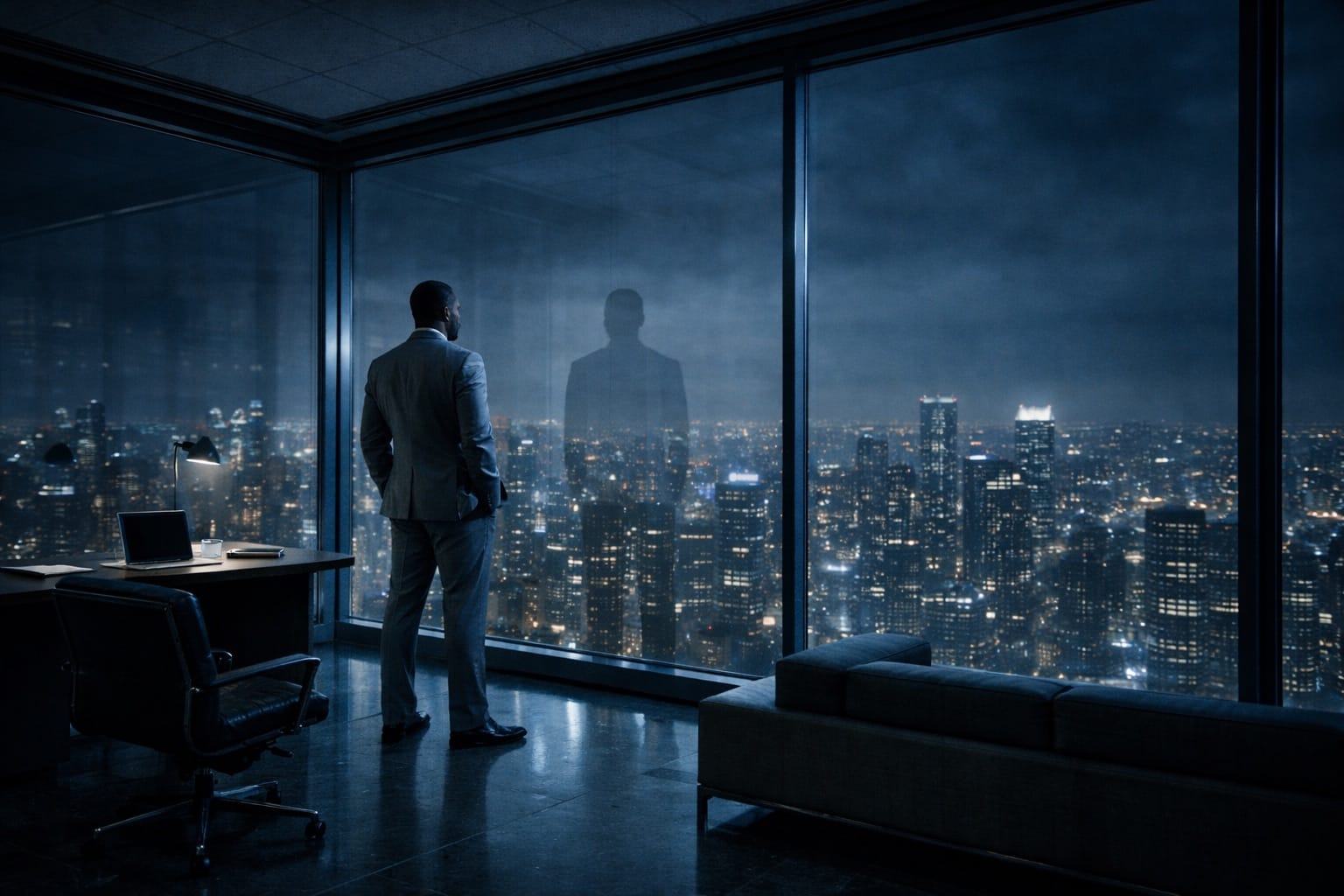
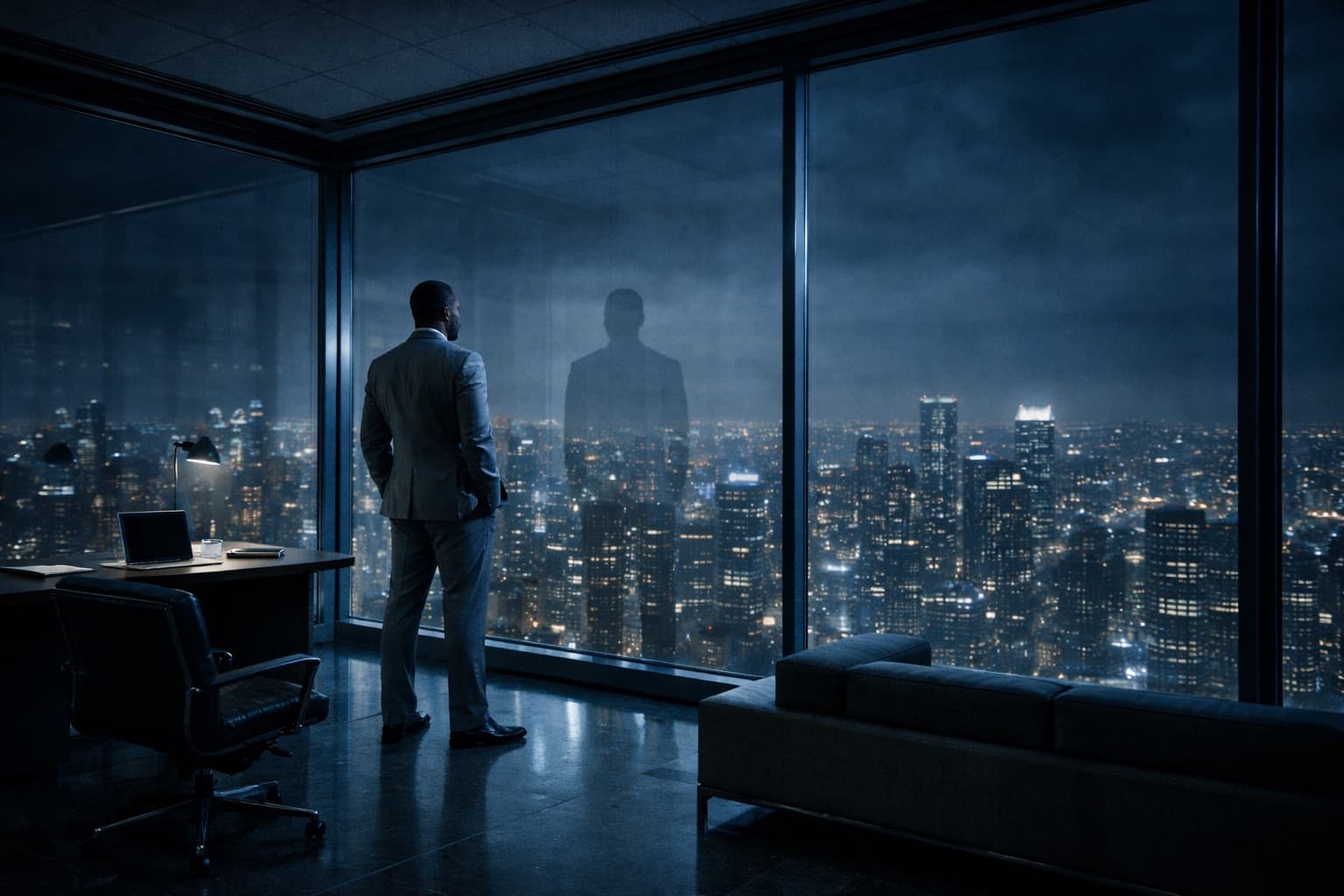
Later, in the new corner office, floor-to-ceiling glass, city lights painting gold and red across the dark, he sat alone in the leather chair that still carried the faint scent of newness. The door was closed. The lights were off except for one desk lamp.
He rose and walked to the window. His reflection gazed back: perfectly tailored gray suit, white shirt crisp, tie knotted with exactness, face arranged in the neutral expression that had become reflex.
No silver bracelet tonight; he had removed it months earlier, telling himself it disrupted the palette. No music in his ears. No trace of palm oil, shea butter, or anything that once reminded him he was alive.
He pressed his forehead to the cold glass. The city continued below, indifferent.
He had won.
He held the title, the office, the salary that ensured Fatou would never know the financial fear he once carried.
Yet the man in the reflection no longer answered to Ibrahima Ndiaye.
He was only the shape the room had demanded.
